Original Transcript
Why Alphabet (Google)?
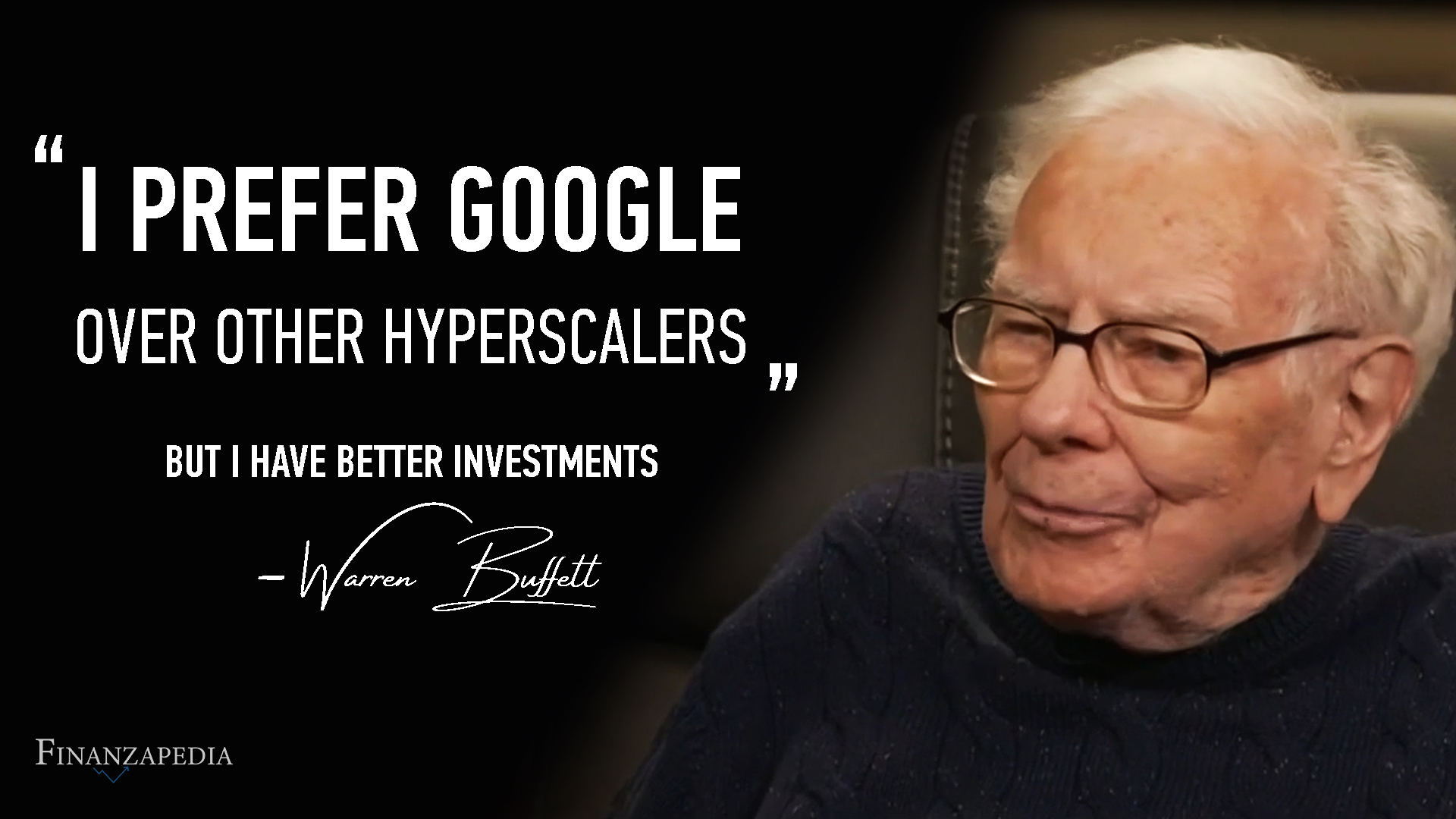
BECKY QUICK: Why do you like Alphabet above all others, and what made you initiate this position?
W. BUFFETT: I would say that I don't like it as well as at least four or five other businesses that we own — other than Apple, the railroad (BSFN), American Express. Well, you know, I'm not going to give you the whole four, but you like it enough to make it a huge position.
I like Berkshire that way. I mean, Berkshire earned high returns on capital — and I'm not talking about using the tricks of leveraging, that sort of things.
BECKY QUICK: But I'm talking about why Alphabet versus the other Magnificent Seven, or the other hyperscalers who are doing the same thing — spending a lot of money, Amazon, Microsoft, whoever it may be — to try and win in AI.
W. BUFFETT: Well, I don't want to sit around knocking the others. They don't have any choice.
BECKY QUICK: To spend like this, you mean?
W. BUFFETT: Yeah. They're now playing a game — in many cases, a game they don't want to play.
IBM would have loved it if they just kept playing the game IBM was playing in the 30s, 40s, 50s, 60s. And then somebody came along and said: we'll get a better result for you — achieving the objective of all the customers you have. Because that's all you're going to have: if you don't have happy customers, you don't have customers over time.
And the customer's not dumb. Wall Street can be very dumb — they can dream. But a guy with a grocery store can't dream. I went over to my grandfather's grocery store — we had one store in 1869, and one store in 1969.
Other people were earning high returns on capital, some on a national scale. A&P, which people don't associate with anymore — in the 1930s they were enemy number one of trust busters in Washington. They had a very, very good hand. And that hand disappeared.
So it's a different game now.
BECKY QUICK: And you like this game — you understand this game more than you understood the game they were playing before?
W. BUFFETT: Yeah, well, there are all kinds of games I don't understand. Why should I expect to make money in things I don't understand?
BECKY QUICK: But this game — what do you understand about it? Because most people would say you'd never buy technology stocks. And I think you've said the same yourself.
W. BUFFETT: Yeah, but I've done it. And actually one of the most successful companies I was associated with — going back to 1958 — was Data Documents. We started Data Documents because a couple of pals of mine read in the paper that IBM had settled an antitrust suit by divesting — they had to divest 50% of the capacity of what was their best business. And everybody knew what their best business was.
Now, it ran out after 10 or 15 years, and I knew some of the people that caused it to run out. But if you have a wonderful business, you are going to be subject to attacks. So it's not a question of whether it was wonderful yesterday. The question is: how long is it going to be wonderful?
Key Takeaways
- Buffett bet $31B on Google specifically — not Amazon, not Microsoft — signaling a calculated conviction that Alphabet is best positioned to win the AI era, even while admitting it ranks below his top holdings
- The hyperscalers have no exit: Buffett's core thesis is that Google, Microsoft and Amazon are forced to spend hundreds of billions or risk obsolescence — the question is who survives with the best business model intact
- Berkshire sold out of AMZN in the last 13F
- $350B+ still in cash: Berkshire's war chest keeps growing because the market hasn't corrected at all — Buffett, as mentioned in his last interview, is waiting for the phone to stop being answered
- The casino is at all-time highs: One-day options, short squeezes, retail gambling — Buffett says we've never seen speculation this extreme, but that doesn't make investing bad — it makes patience even more important
FINANZAPEDIA TAKE
We believe everyone's asking the wrong question about Buffett and Google.
The question isn't "what does Buffett even know about tech?", "does Buffett understand AI?" He's the first to say he doesn't. The question is: does Buffett understand moats? That's literally his entire career: recognizing when a business has a structural advantage so durable that even smart, well-funded competitors can't dislodge it. That's what he sees in Alphabet.
The hyperscalers — Microsoft, Amazon, Meta — are all spending hundreds of billions in a race that, historically, arms races don't produce winners. They produce exhausted survivors. IBM would have loved to keep playing its 1950s game. A&P had the best hand in American retail in 1930 and had no stores worth mentioning by 1970. The game changes. The hand disappears.
But Google's hand is different. Not because its AI models are the best (even though Gemini is always among the top models), not because its cloud is the largest (it is currently still behind AWS and Azure as of 07/2026); but because Google is the only company in the AI race that controls every layer of the value chain simultaneously: from custom silicon (TPUs) all the way to the consumer's attention (Search, YouTube, Android) with models (Gemini), cloud (GCP), and the world's richest behavioral data in between.
Microsoft needs OpenAI. Amazon needs Anthropic. Meta needs the open-source community. Google needs no one.
That's the moat. That's why Buffett spent $31 billion. Not because he's predicting Google wins. Because he's betting Google doesn't need to — it already built the casino. And as he just told us: the casino has never been more crowded.