Original Transcript from 2022 Annual Meeting:
BECKY QUICK: This question comes from Foster Taylor, in Tulsa, Oklahoma. He said he recently listened to the Berkshire Hathaway 2008 Annual Meeting, where you talked about global oil production. At the time you talked about major ramifications if global oil production went below 85 million barrels in 25 years. We are at the 14-year mark, and global oil production looks to be 79 million barrels. At the same time, we’re depleting our strategic oil reserves. Should the United States be doing something differently, and do you see consequences to these actions in the next ten years if we do not become more proactive?
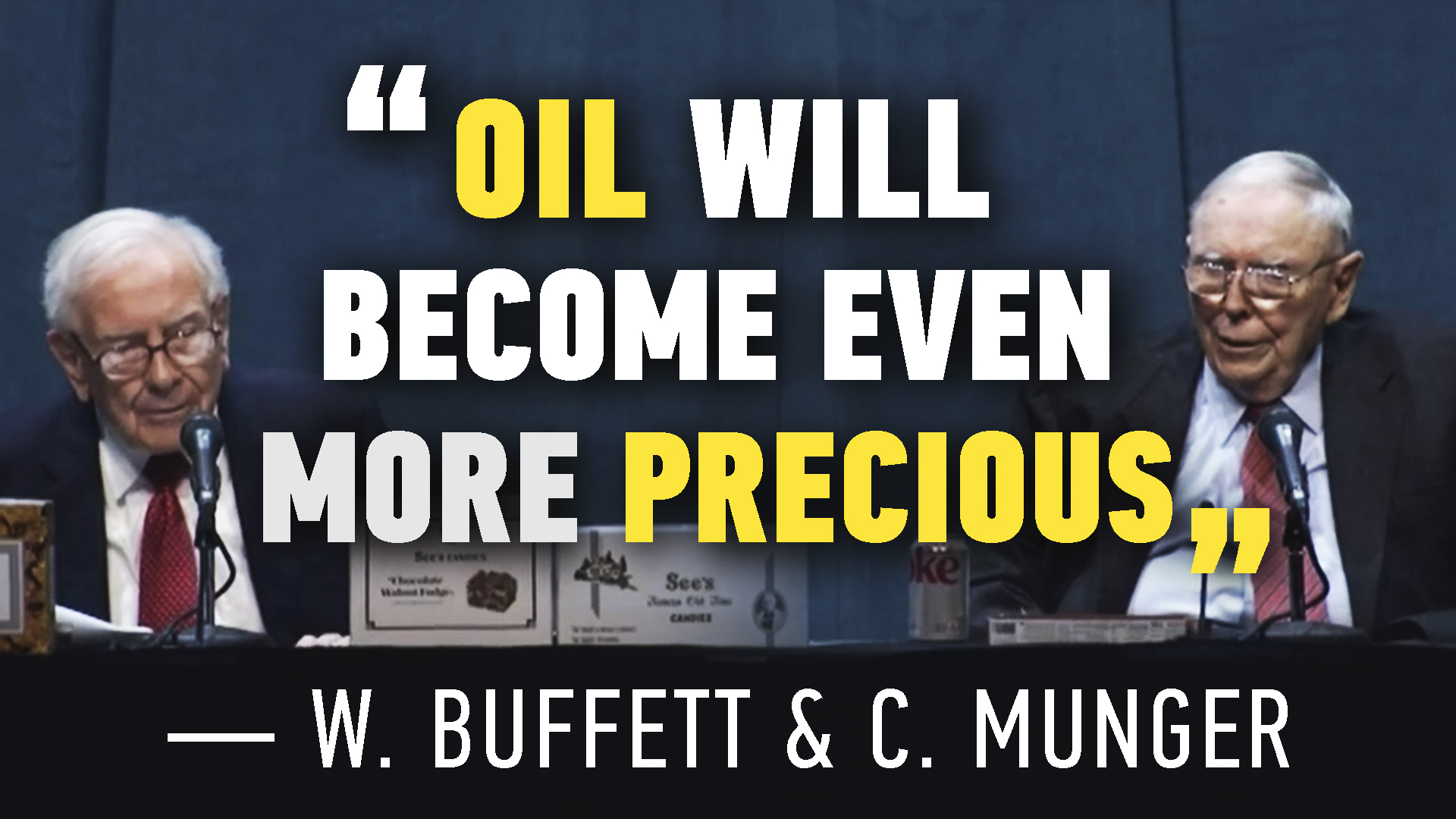
Oil will become very precious over the next 200 years.
WARREN BUFFETT: Well, Charlie’s the expert on oil.
CHARLIE MUNGER: Well, but — (Laughs)
WARREN BUFFETT: Only compared to me. (Laughter)
CHARLIE MUNGER: Samuel Johnson said, “It’s hard to determine the order of precedency between a louse and a flea.” And it’s hard to tell which of us is more incompetent in oil. (Laughter)
WARREN BUFFETT: We’re still competing. (Laughs)
CHARLIE MUNGER: I have a different view on this subject. I like having big reserves of oil. If I were running the benevolent despot of the United States, I would just leave most of the oil we have here, and I’d pay whatever the Arabs charge for their oil and I’d pay it cheerfully and conserve my own. I think it’s going to be very precious stuff over the next 200 years. And nobody else has my view, so it doesn’t bother me, I just think they’re all wrong.
WARREN BUFFETT: Yeah. (Laughter) Well —
CHARLIE MUNGER: But at any rate, that is not the normal view.
WARREN BUFFETT: And we’ve been pretty flexible on our own view. I mean, actually, the Federal Government is serving up however many billion barrels of the stuff into the economy. And, you know, it wasn’t that long ago that, you know, the idea that anybody produced a barrel of oil was somehow something terrible. I mean, just try doing without 11 million barrels a day and see what happens tomorrow. It is something that everybody has a feeling on, immediately. And, you know, this gets into a whole bunch of different tribes of sorts, and you offend an awful lot of people if you talk in any way about it. But, in the end I think, at the moment at least, most people feel that it’s nicer to have some oil in this country than not have it. And we’re using a lot of it. And if we were to try and change over, in three years, or five years, nobody knows what would happen, but the odds that it would work well are extremely low, it seems to me. Charlie, why don’t you say something more dramatic so you’ll be the one that offended the most people? (Laughter)
CHARLIE MUNGER: Well, if you stop to think about it, the oil industry is being so vilified now, I can hardly think of a more useful industry, and I don’t know about wildcatters, but certainly the petroleum engineers I know, and the people who design our oil refineries, and pipelines, are some of the finest and most reliable people I know. And I see very little trouble (Applause) with the oil supply thing in the United States. So I’m basically in love with Standard Oil. And I don’t have this feeling that it’s an evil, crazy place. I wish the rest of the world worked as well as our big oil companies.
Finanzapedia's Takeaways:
Key Takeaways
- The "Precious" Strategy: Charlie Munger believes the U.S. should "cheerfully" pay for foreign oil now and conserve its own reserves, as oil will become an incredibly precious resource over the next 200 years.
- Economic Reality: Warren Buffett argues that the modern economy is entirely dependent on oil, noting that "doing without 11 million barrels a day" would lead to immediate disaster for the country.
- Defense of the Industry: Both men push back against the "vilification" of the oil industry, with Munger praising petroleum engineers as some of the most reliable people and calling the industry one of the most useful in existence.
- Humility in Experts: Despite their massive investments, both Buffett and Munger joked about their own "incompetence" regarding oil production forecasts, focusing on the long-term utility of the resource rather than short-term price gambling.