As Warren Buffett prepares to step down from Berkshire Hathaway after more than six decades, the investment world is scanning for his philosophical successors. In the U.S., names like Greg Abel and Todd Combs dominate succession headlines. But in China, the search for a “Buffett Successor” has been answered by a man who never sought the title: Duan Yongping.
Duan isn’t a copycat. He’s a parallel evolution. Before he ever bought a stock, he built iconic consumer brands. Before he became a market legend, he walked away from his own empire. And long before value investing went viral in China, he was practicing it in silence.
Today, Duan is both mentor and myth to millions of Chinese retail investors. His legacy isn’t built on leverage, algorithmic trading, or viral stock tips. It’s built on a rare combination: builder’s intuition, investor’s discipline, and a philosophy that treats patience as a competitive advantage.
From Factory Floor to Brand Empire
Duan’s story begins in the early 1990s, when he took over a failing electronics factory in Guangdong. With limited capital but sharp market instincts, he launched Xiao Ba Wang (“Little Tyrant”), a locally adapted, affordable home gaming console modeled after Japan’s Famicom. A Jackie Chan TV campaign and aggressive pricing turned it into a cultural phenomenon. By 1995, Little Tyrant controlled over 80% of China’s home gaming market and generated more than ¥1 billion ($120M+) in annual sales.
Yet at the peak of success, Duan walked away.
The parent company refused his proposal for employee equity, and profits were routinely diverted to prop up other struggling subsidiaries. Frustrated by misaligned incentives and short-term governance, Duan left with a handful of loyal colleagues and founded BBK Electronics in 1995.
BBK wasn’t just another electronics brand. It was a blueprint. Duan prioritized branding, channel incentives, and a corporate ethos he called “benfen” (本分) — roughly translated as “doing your part right, staying in your lane, and refusing to cut corners.” After a one-year non-compete expired, BBK’s ads dominated prime time on China Central Television. The brand became synonymous with educational electronics and audio gear, and its DNA would later power the global rise of OPPO, vivo, and OnePlus.
At age 40, with his companies thriving, Duan made his second unexpected move: he stepped back from daily operations, relocated to California, and turned his attention to investing.
The $2 Million Bet That Changed Everything
Duan’s investing debut in 2002 reads like a masterclass in contrarian value investing. NetEase, then battered by the dot-com crash, was trading around $0.80 per share. Drawing on his hardware background, Duan recognized the company’s underlying gaming and portal assets were deeply undervalued. He invested roughly $2 million for a 5% stake. Within two years, he exited for nearly $200 million — a 100x return.
It wasn’t luck. It was pattern recognition, patience, and a willingness to buy when fear was at its peak.
From there, Duan’s portfolio took shape:
Kweichow Moutai: A long-term position in China’s premium liquor monopoly, prized for pricing power and brand moat.
Apple: An early bet made before Berkshire Hathaway’s massive accumulation, rooted in his understanding of ecosystem loyalty and hardware-software integration.
General Electric: A crisis-era purchase during the 2009 financial downturn, later sold at a substantial profit.
Across every position, the same discipline applied: buy what you understand, wait for the right price, and hold through noise.
“Slow Is Fast”: The Philosophy Behind the Returns
“Investing is really just common sense.” — Duan Yongping
Duan’s approach mirrors Buffett and Munger so closely that the “Buffett Successor” label feels almost inevitable. But his edge comes from how he translates their principles into practice:
Circle of Competence: “Most companies, I don’t understand” he’s said bluntly. He passes on complex tech, biotech, or financial engineering plays, preferring businesses with transparent cash flows and predictable demand.
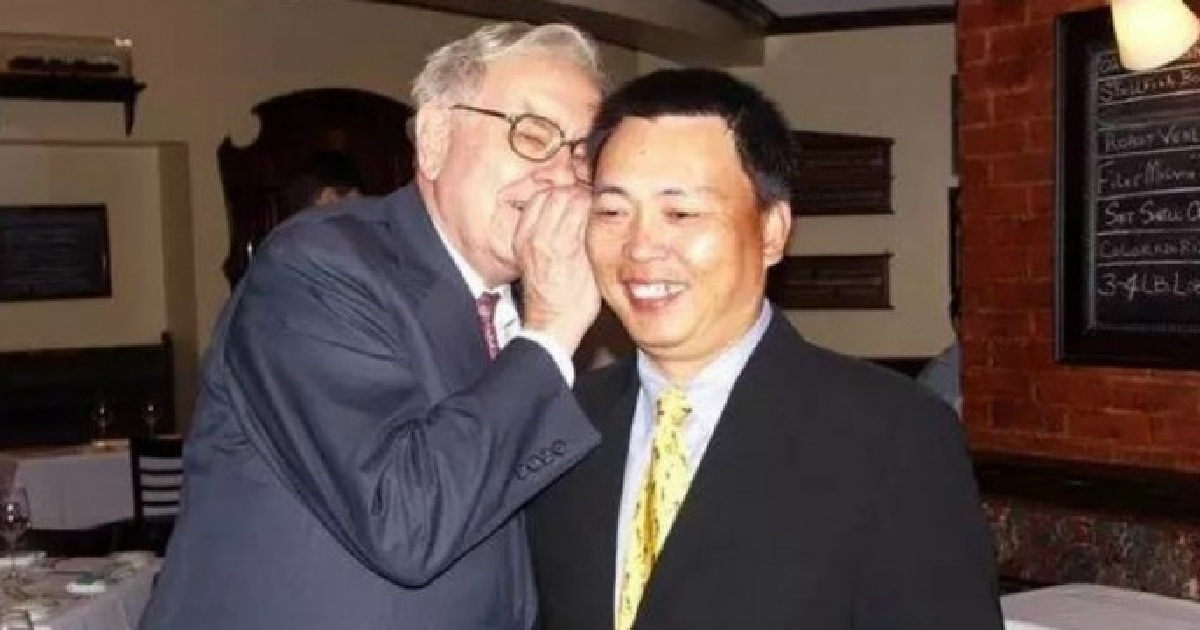
Capital Preservation: He avoids leverage, derivatives, and short-selling. At his 2006 charity lunch with Buffett, Duan asked: “What’s the one thing an investor should never do?” Buffett replied: “Never invest in something you don’t understand, never borrow to invest, and never short.” Duan built his career on those three rules.
Slow Is Fast: In a market obsessed with quarterly returns and viral trades, Duan preaches deliberate compounding. “If you just avoid doing stupid things, the money will come eventually” he often reminds followers.
Underpinning it all is benfen. In business, it meant aligning incentives and refusing to overextend. In investing, it means knowing your limits, respecting the market’s randomness, and letting time do the heavy lifting.
The Mentor Behind the Screen
In the West, Duan remains a niche figure. In China, he’s a quiet institution.
Under the pseudonym 大道无形我有型 (“The Great Way is formless, but I have my style”), Duan is one of the most active voices on Xueqiu, China’s premier investing forum. With over a million followers, he answers questions daily — rarely naming tickers, but constantly sharpening mental models.
When a trader fixated on price targets asked for advice, Duan replied: “Would you still buy this company if the stock market closed for 10 years?”
When followers chased momentum, he warned: “You don’t have to be smart. You just have to be rational.”
His most devoted followers call him Duanzong (Chief Duan) or Laoduan (Old Duan). His posts are treated less as stock calls and more as investing koans — blending Buffett-style pragmatism with almost Zen-like restraint.
And his mentorship extends beyond forums. In 2006, he brought a young, then-unknown engineer named Colin Huang to his charity lunch with Buffett. Duan provided early guidance, capital, and strategic framing that Huang has publicly credited in building Pinduoduo into a $100B+ e-commerce giant. It’s a rare example of value investing’s long game playing out across generations.
Why Duan Matters Now
The “Buffett Successor” is more than a catchy headline. It’s a reflection of how value investing has evolved in emerging markets. While Western finance often rewards speed, complexity, and narrative-driven growth, Duan’s career proves that simplicity, patience, and ethical consistency compound just as powerfully — sometimes more so.
As Berkshire Hathaway transitions leadership, and as global retail investors navigate volatile, algorithm-driven markets, Duan’s playbook feels increasingly relevant:
Build or buy businesses with real cash flows and pricing power.
Align incentives before scaling.
Never confuse activity with progress.
Let time reward discipline, not desperation.
Duan never sought fame. He built brands, stepped away, bought quietly, and taught openly. In an era obsessed with overnight returns and celebrity traders, his legacy is a quiet reminder: the best investing doesn’t shout. It compounds.