Energy crises are not aberrations. They are recurring features of the modern economy — and every single one has followed a predictable pattern that governments consistently deny, investors consistently misread, and a small number of prepared individuals consistently profit from.
We analyzed five major energy shocks spanning seven decades: the Suez Crisis (1956), the Arab Oil Embargo (1973), the Iranian Revolution (1979), the Gulf War (1990), and the Russia-Ukraine shock (2022). Here is what the data actually shows — and why it will surprise you.
The Government Playbook: The Same Script Since 1973
Every energy crisis in modern history runs the identical script:
The Official Story | The Historical Reality |
|---|---|
"This is temporary" | It lasts months to years. |
"The government has it under control" | Government intervention consistently makes it worse. |
"Prices will stabilize soon" | Prices spike, then crater when recession destroys demand. |
"Don't panic" | Panic is rational if you are unprepared. |
Case Study: Nixon's 'Project Independence' (1973)
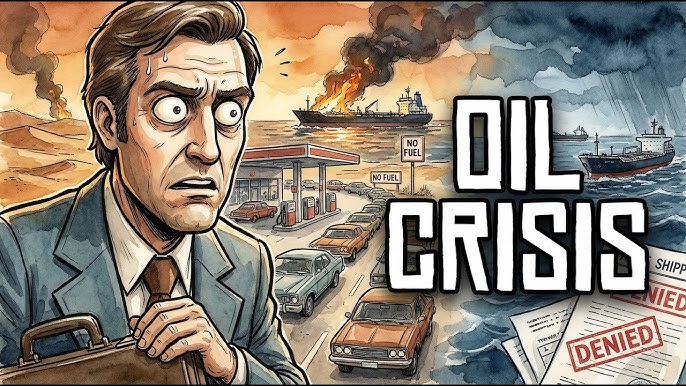
On November 7th, 1973, as American gas stations ran dry and drivers queued in 5-mile lines, President Nixon announced Project Independence: America would be energy self-sufficient by the end of the decade. The announcement was operationally impossible before the words left his mouth.
What actually happened:
American oil imports increased every year after that speech.
Nixon's Emergency Petroleum Allocation Act capped domestic oil prices, creating a two-tier market: domestic oil sat artificially below world prices. Domestic producers had no incentive to drill; refiners couldn't source enough crude.
The government's price controls created the shortage it claimed to be solving.
FAST FACT
By February 1974, one in five American gas stations had no fuel. States imposed odd-even license plate rationing. The government had intervened aggressively — and produced the worst peacetime energy crisis in American history.
Sponsored Video
Finding #1: Energy Stocks Are NOT Automatic Winners
This is the most important and consistently misunderstood finding across seven decades.
The 1973 Embargo — Oil Quadrupled, Energy Stocks Fell
A basket of the 8 largest U.S. oil companies fell approximately 35%.
Exxon (XOM) posted record profits. Texaco's profits doubled.
It didn't matter. The broader bear market overwhelmed the commodity tailwind.
Investors sold everything — including the most profitable companies in America.
The time horizon paradox:
Bought oil stocks the week the embargo started? Lost money for 18 months.
Held for the full decade? Made a fortune — roughly 200% returns vs. 50% for the broader market.
The 2022 Russia-Ukraine Shock — Energy Was the Only Sector That Won
Energy was the sole positive S&P sector (+60% while the index fell 20%).
Exxon Mobil recorded $55.7 billion in profit — the largest annual profit of any Western oil company in history.
Shell posted its highest annual profit in 115 years.
Occidental Petroleum (OXY) surged over 100% after Berkshire Hathaway (BRK) accumulated a stake worth approximately $12-13 billion at its peak.
But this only worked because the broader market was in a correction, not a structural bear. The 2022 energy trade succeeded because every other sector got hit harder, not because energy was uniquely immune.
IMPORTANT
In a true crash, everything sells (1973). In a correction, the strongest sector leads (2022). The difference between those two scenarios is everything.
Finding #2: Gold Requires Inflation AND Easy Money — Not Just Crisis
The most persistent myth in finance is that gold is a 'crisis hedge.' It is not. Gold is a monetary debasement hedge. The distinction is critical.
The 1970s Bull Run ($35 → $850)
Gold's rise from its fixed $35 price (released by Nixon in August 1971) to its peak of $850 on January 21, 1980 was not driven by geopolitical crisis alone. It required a perfect storm:
Inflation reaching 15% by 1979.
A Federal Reserve chronically behind the curve for years.
A dollar so weak that the Carter administration issued Treasury bonds denominated in West German marks and Swiss francs (the so-called 'Carter bonds') to attract foreign creditors who no longer trusted the dollar.
The Soviet invasion of Afghanistan adding geopolitical fear.
Gold peaked at $850 on January 21, 1980. Paul Volcker's Fed had already begun aggressively tightening since October 1979 — hiking rates to a peak of approximately 20% by mid-1981. As it became clear the Fed would prioritize inflation over growth, gold began its long decline, ultimately falling to around $250 by 2001 — approximately 21 years of bear market in the metal.
The 1990 Gulf War — Genuine Oil Shock, Gold Barely Moved
The Gulf War produced a real oil supply disruption. Gold barely responded. Why? The crisis was short, inflation stayed low, and the Fed was not printing. Gold does not respond to drama. It responds to monetary policy.
The 2022 Ukraine War — 9% Inflation, Gold Ended Flat
Despite the highest inflation in 40 years and a war in Europe, gold ended 2022 essentially flat. The reason: the Fed was aggressively raising rates and the dollar surged to 20-year highs. Tight money, strong dollar, gold goes nowhere — regardless of how bad the headlines are.
TIP
Watch the Fed, not the oil price. Gold moves when central banks accommodate inflation. Gold stalls when central banks fight it. This has been true in every energy crisis since 1971.
Finding #3: Government Bonds Failed in Every Energy Crisis
Every single one:
1973: Yields rose as inflation surged. Bond prices fell.
1979: Yields exploded toward 15–20%. Worst sustained bond bear market in modern history.
2022: Worst bond year in four decades, with long-duration Treasuries losing 25–30%.
Energy crises are inflationary events. Inflation is the primary enemy of fixed-income instruments. When oil prices spike, the only long bonds working in your favor are the ones you are selling.
The only rational fixed-income holding during an energy shock is the shortest-duration instrument available: 3-month T-Bills. Liquid, flexible, and continuously repriced to current rates rather than locked into the last rate cycle.
Finding #4: The Counterintuitive Winner — Logistics
The asset class that dominated across multiple energy crises is not oil. Not gold. It is logistics: the physical infrastructure that moves energy from where it exists to where it is needed.
Case Study: Aristotle Onassis and the Suez Crisis (1956)
In 1956, Egypt nationalized the Suez Canal. Oil tankers could no longer transit from the Persian Gulf to Europe via the shortest route. Onassis was in serious trouble — his tanker fleet had been sitting idle for over two years as the shipping market remained depressed, and he had considered selling the entire fleet to Royal Dutch Shell.
What happened next:
Tanker spot rates surged from roughly $4 per tonne to $60 per tonne — an increase of approximately 1,400%.
Onassis's uncontracted tankers became among the most valuable assets in world shipping overnight.
He generated approximately $2 million in profit per voyage.
In 1957 alone, he made $70 million — equivalent to roughly $740 million today.
FAST FACT
He went from considering bankruptcy to one of the wealthiest men alive in roughly 12 months. He didn't own the oil. He owned the means of moving it around the bottleneck.
The Mechanism
Energy crises do not reward the owners of oil. They reward the owners of the chokepoint infrastructure — whoever owns the capacity to move energy around the disruption commands premium pricing. This mechanism has been consistent across every major energy shock:
Suez closed (1956) → Tanker rates +1,400%. Onassis made a fortune.
Arab embargo (1973) → U.S. pipelines and refining capacity at premium.
Iran-Iraq War (1980s) → Gulf tanker operators commanded war-risk premiums.
Russia-Ukraine (2022) → European LNG import infrastructure, U.S. pipeline operators, and tanker companies all repriced sharply as European energy flows permanently restructured.
In every case, the same principle: whoever owns the logistics around the disruption owns the crisis.
The relevant universe of companies when this mechanism activates includes tanker operators, midstream pipeline companies, and refiners in geographically stable regions outside the conflict zone. These are cyclical businesses, not Buffett-style forever holdings, but tactically they represent the most consistent historical opportunity during supply disruptions.
IMPORTANT
Buffett's Lesson: He doesn't own shipping companies as core holdings because they're capital-intensive, cyclical, and lack durable moats. If you trade this — do it tactically with a small position, only below fair value, with a clear exit plan.
Finding #5: The Right Side of the Disruption
Beyond the commodity and its logistics infrastructure, the most durable wealth from energy crises has often been made by companies that solved the problem oil created — not by speculating on oil itself.
Case Study: Japanese Automakers Post-1973
Before the Arab Oil Embargo, American automakers dominated on volume and engine displacement. The average Big Three product returned around 13.5 mpg. Detroit's entire business model assumed cheap, abundant oil.
After the embargo:
American car sales fell from approximately 9.7 million to 7.5 million units in a single year.
Japanese imports — fuel-efficient Toyotas, Hondas, and Datsuns — went from roughly 8% of the U.S. market in 1976 to approximately 21% by 1980.
By 1980, Japan surpassed the United States as the world's largest automobile producer for the first time in history.
The oil shock didn't merely move money from one stock to another. It permanently restructured an entire global industry. The winners were not oil companies. They were the companies that built a solution to the problem oil created.
Identifying the equivalent structural shift in any given energy crisis — which industries get permanently disrupted, and which new industries absorb the capital flow — is often the highest-return long-term trade available. It requires patience and conviction. It takes years to play out. But the historical evidence is consistent.
Finding #6: The Leverage Trap — The 1970s Farmland Warning
This finding comes with a brutal warning that remains as relevant today as it was 50 years ago.
The 1970s Farmland Boom
During the 1970s energy and food inflation:
Farmland values nearly quadrupled.
Crop prices doubled and tripled. Soybeans hit $11/bushel.
The federal government actively encouraged farmers to 'plant fence row to fence row.'
Conventional wisdom said energy-driven food inflation would be permanent.
Farmers borrowed against rising land values to buy more land. They leveraged heavily — rationally, given the incentives at the time.
The 1980s Farm Crisis
Then Paul Volcker raised interest rates to approximately 20% to break inflation. The consequences:
Iowa farmland lost approximately 60% of its value between 1981 and 1986.
By the end of the decade, an estimated 300,000 farmers had defaulted on their loans.
The suicide rate among farming populations ran approximately 4 times the national average through the 1980s.
REMEMBER
The energy crisis of the 1970s created the farm crisis of the 1980s. Farmland as an inflation hedge was a sound mechanism. Farmland financed with debt on the assumption of permanent inflation was a catastrophe.
The asset wasn't wrong. The leverage was wrong.
How Energy Crises Actually End: The Uncomfortable Truth
Here is what seven decades of data prove but no government has ever admitted publicly:
IMPORTANT
Every energy shock in the historical record ended the same way. Not when supply returned. When demand was destroyed.
1973 Arab Oil Embargo: Ended when the global recession it caused cut oil consumption sufficiently.
1979 Iranian Revolution crisis: Ended when Volcker's rate hikes crushed the economy and demand collapsed.
2022 Russia-Ukraine spike: Ended when European industrial activity contracted and demand fell.
In every case, governments did not solve the supply problem. They waited — or accidentally engineered — a recession severe enough to make the supply problem irrelevant.
The question during any energy shock is never just about supply or geopolitics. The central question is always: How much economic damage will be tolerated before demand falls enough to collapse prices? That is the variable that determines timing. And that variable is driven by central bank policy.
The Intelligent Investor's Framework for Energy Crises
1. Energy Stocks: Hold Through Volatility, Don't Chase
If you own energy stocks before the crisis, hold. Full-cycle returns across the 1970s ran approximately +200% vs. +50% for the broader market. But the first year can be brutal even as profits surge.
If you're considering entering mid-crisis: wait for the first major panic sell-off, run a full discounted cash flow analysis, and require at least a 30% margin of safety to fair value before buying. Do not chase the spike.
2. Watch the Fed, Not the Oil Price
This single variable determines which assets win the second half of every energy crisis:
Fed stays accommodative → Gold moves higher. Energy stocks outperform. Inflation runs hot.
Fed tightens aggressively → Gold stalls and reverses. Short-term bonds eventually become attractive after the yield spike peaks. Recession destroys oil demand; energy stocks crater.
History shows politicians resist recessions. The Fed typically tries to thread the needle. They typically fail. Recession follows. Position accordingly: hold dry powder (T-Bills), stay in wonderful businesses, and wait for the opportunity that recessions always create.
3. The Overlooked Trade: Logistics
The Onassis mechanism activates in every major supply disruption. The companies that own the infrastructure to move energy around the bottleneck — tanker operators, pipeline companies, refiners outside the conflict zone — reprice sharply. This is a tactical trade, not a core holding. Require a margin of safety, have a clear exit thesis, and size it accordingly (5–10% of portfolio at most).
4. Never Leverage Into Real Assets on a Permanent Inflation Assumption
Real assets as inflation hedges: sound mechanism. Borrowing against them during a crisis on the assumption that energy-driven inflation is permanent: how fortunes die. The 1970s farmers proved it. The mechanism is not the problem. The leverage kills you when Volcker arrives.
5. The Fortress Holds
The deepest lesson from seven decades of energy crises is not about oil, gold, or logistics. It is about portfolio architecture. The investors who built anti-fragile portfolios — productive assets generating cash flow, dry powder ready to deploy, no leverage, no panic — consistently came out of every energy shock stronger than they entered it.
Energy crises don't create wealth. They reveal who built a fortress and who built a house of cards.
The leveraged real estate investors of the 1970s lost everything in the 1980s.
The bond holders of 1973 and 1979 lost purchasing power for a decade.
Berkshire Hathaway's portfolio — built on wonderful businesses with pricing power and durable moats — compounded from approximately $100 billion to over $1 trillion through multiple oil shocks, financial crises, and wars.
TIP
You may not own a tanker fleet. But you can own Coca-Cola, Visa, and Costco. You can hold 5% T-Bills and deploy them when everyone else panics. You can avoid bonds, avoid leverage, and avoid FOMO. The path is available. The discipline is the only variable.