In the analysis of a company's financial health, few items are as closely watched and universally understood as cash. However, on financial statements, you will almost always see it accompanied by a specific phrase: "and cash equivalents." This combination is the bedrock of a company's liquidity and provides an instant snapshot of its ability to operate, invest, and survive.
This article will break down exactly what cash and cash equivalents are, how they function in the world of accounting and finance, and why they are a fundamental metric for both company managers and external investors.
What are Cash and Cash Equivalents?
Cash and Cash Equivalents (CCE) is an accounting line item that appears on the very first line of a company's balance sheet, within the "Current Assets" section. It represents the value of all a company's assets that are either physical cash or can be converted into cash almost immediately.
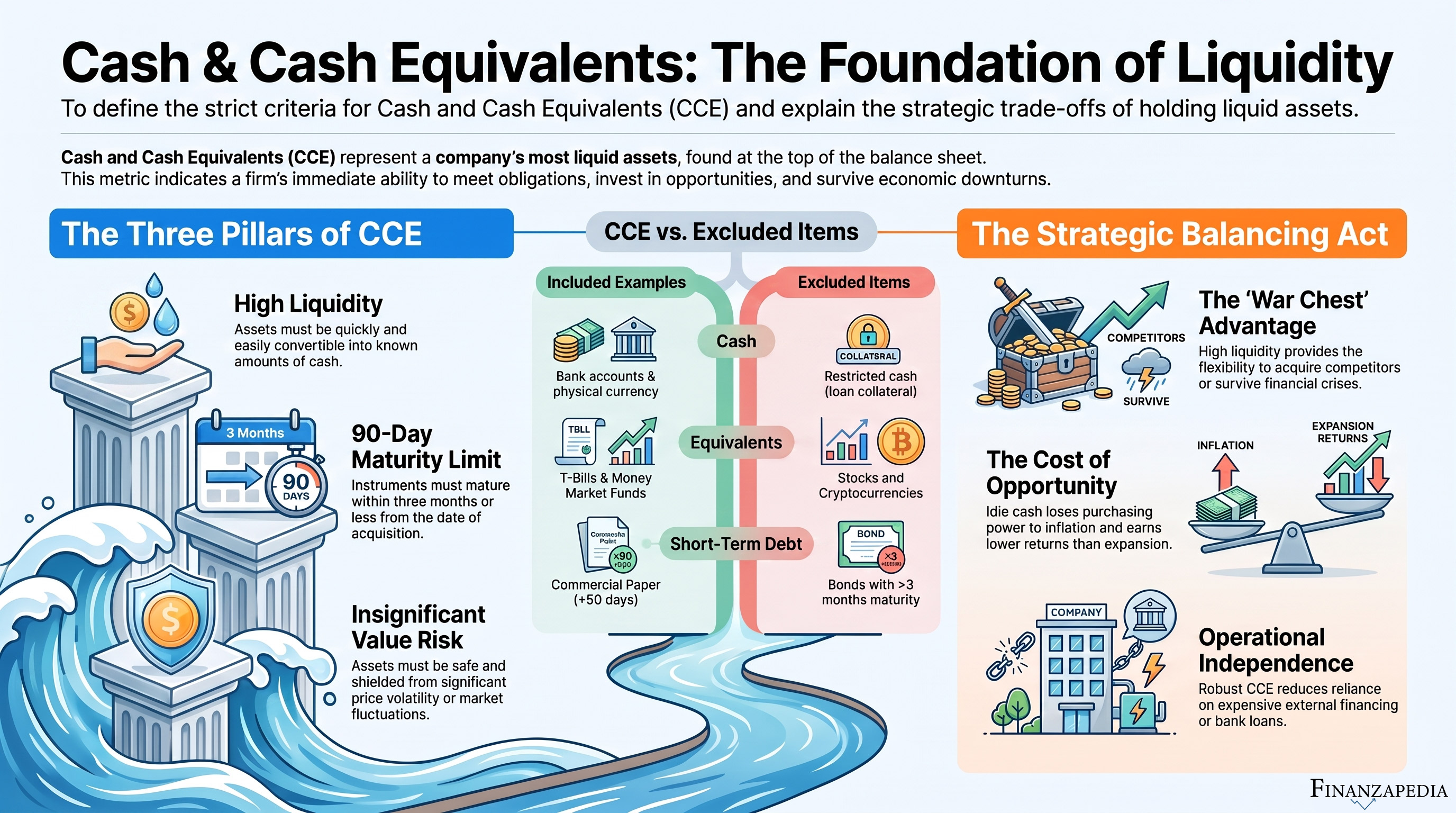
For an asset to be classified within this category, it must meet three strict criteria defined by accounting standards (such as IFRS or US GAAP):
Be highly liquid: It must be easily and quickly convertible into a known amount of money.
Have a very short-term maturity: Generally, this is considered a period of three months (90 days) or less from the date of acquisition. This is a crucial point; a one-year government bond is not a cash equivalent, but one purchased when it only has two months left until maturity would be.
Present insignificant risk of change in value: The asset must be very safe and not subject to significant price volatility. This automatically excludes assets like stocks, cryptocurrencies, or long-term bonds.
In essence, this item represents the most accessible money a company has to cover its short-term obligations, such as paying suppliers, salaries, taxes, or dealing with unexpected expenses.
How Does It Work?
The concept of "Cash and Cash Equivalents" goes beyond a simple figure on a balance sheet. It is an active tool in financial management and a key indicator for analysis.
From a Management Perspective:
A company with a massive amount of money sitting in a standard checking account (pure cash) is missing an opportunity. That money is idle and, due to inflation, loses purchasing power every day. Therefore, a company's treasury department seeks to optimize this "idle cash."
The goal is to invest cash not needed for immediate daily operations into very low-risk, high-liquidity instruments that generate a small return. This is where cash equivalents come in. The company invests in Treasury Bills or a money market fund, earning modest interest while ensuring they can get that money back in a matter of days if needed. It is a constant balance between safety, liquidity, and profitability.
From an Investor or Analyst Perspective:
For an investor, this figure is fundamental to evaluating a company's financial health and solvency.
Liquidity Analysis: It is the primary component for calculating key liquidity ratios. For example, the Cash Ratio measures a company's ability to pay its current liabilities using only its cash and equivalents. A healthy ratio indicates a strong capacity to meet short-term debts.
Connection to the Cash Flow Statement: The balance sheet shows cash at a specific moment, but the Statement of Cash Flows explains how that figure was reached over a period. It shows if cash was generated through business operations (the healthiest way), through issuing debt (financing), or by selling assets (investing).
Strategic Flexibility Evaluation: A company with a large cash reserve has a "war chest." It can seize strategic opportunities (like acquiring a competitor at a good price), fund research and development, or weather an economic crisis without having to resort to external financing, which might be expensive or unavailable.
Examples of Cash and Cash Equivalents
To understand it better, let's break down the components with concrete examples:
Components of "Cash":
Cash on hand: Physical coins and bills held on the company's premises.
Bank balances: Money deposited in checking or current accounts available immediately.
Demand deposits: Savings accounts or other bank deposits that have no withdrawal restrictions.
Components of "Cash Equivalents":
Treasury Bills (T-Bills): Short-term debt instruments issued by the government (e.g., 30, 60, or 90 days). They are considered the safest financial assets in the world.
Commercial Paper: Unsecured, short-term debt issued by corporations with high credit ratings.
Money Market Funds: Investment funds that invest exclusively in high-quality, short-term debt instruments. They offer high liquidity as they can be bought and sold daily.
Certificates of Deposit (CDs): Time deposits at a bank. To be considered a cash equivalent, their original maturity must be three months or less.
What is NOT included: Stocks of other companies, cryptocurrencies, bonds with a maturity longer than three months, or "restricted cash" (money set aside as collateral for a loan, for example).
Benefits and Disadvantages of Accumulating Cash
Holding a solid cash position is generally positive, but an excess can also have drawbacks.
Benefits:
Solvency and Safety: The most obvious benefit is the ability to pay bills on time. It provides a fundamental safety net against unforeseen events.
Strategic Flexibility: It allows a company to act quickly to acquire a competitor, invest in new technology, or buy back its own shares if it considers them undervalued.
Financial Independence: Reduces dependence on banks or capital markets. In a credit crunch, a cash-rich company can continue operations while competitors struggle.
Disadvantages:
Opportunity Cost: This is the biggest drawback. Every dollar sitting in a low-yield account is a dollar not being invested in higher-return projects, such as business expansion or R&D.
Inflation Erosion: Cash loses purchasing power over time. A 1% return on a cash equivalent doesn't help much if inflation is at 3%.
Signal of Stagnation: For investors, a mountain of cash that grows endlessly can be a red flag. It might indicate that management cannot find attractive investment opportunities, suggesting a lack of innovation.
Questions and Answers (FAQs)
Q: Why doesn't a company just invest its cash in the stock market for a higher return? A: Because of risk and volatility. Cash and equivalents are meant to cover short-term operational needs. The company must be certain it can access a known amount of money at any time. If the market drops 20%, the company might not be able to pay its employees or suppliers.
Q: Is "restricted cash" included in this category? A: No. Restricted cash is money the company has but cannot use freely because it is reserved for a specific purpose (like a loan guarantee). It is reported separately.
Q: How does a company's cash level affect its stock price? A: Indirectly. A strong balance sheet is seen positively as it reduces financial risk. However, too much unproductive cash for a long time can be a negative signal. It depends on the context and the industry.
Conclusion: The Bottom Line
Cash and Cash Equivalents are much more than a simple accounting figure; they are the lifeblood of a company. They represent its health, its ability to react, and its preparation for the future. For managers, it is a tool that must be managed with a delicate balance between safety and profitability. For investors, it is a transparent window into the solvency, financial discipline, and strategic vision of the company.
Analyzing this line item—understanding where the cash comes from and how it is being used—is a fundamental and non-negotiable step in any rigorous financial analysis. In a world full of complex metrics, sometimes the simplest and oldest indicator remains one of the most powerful.