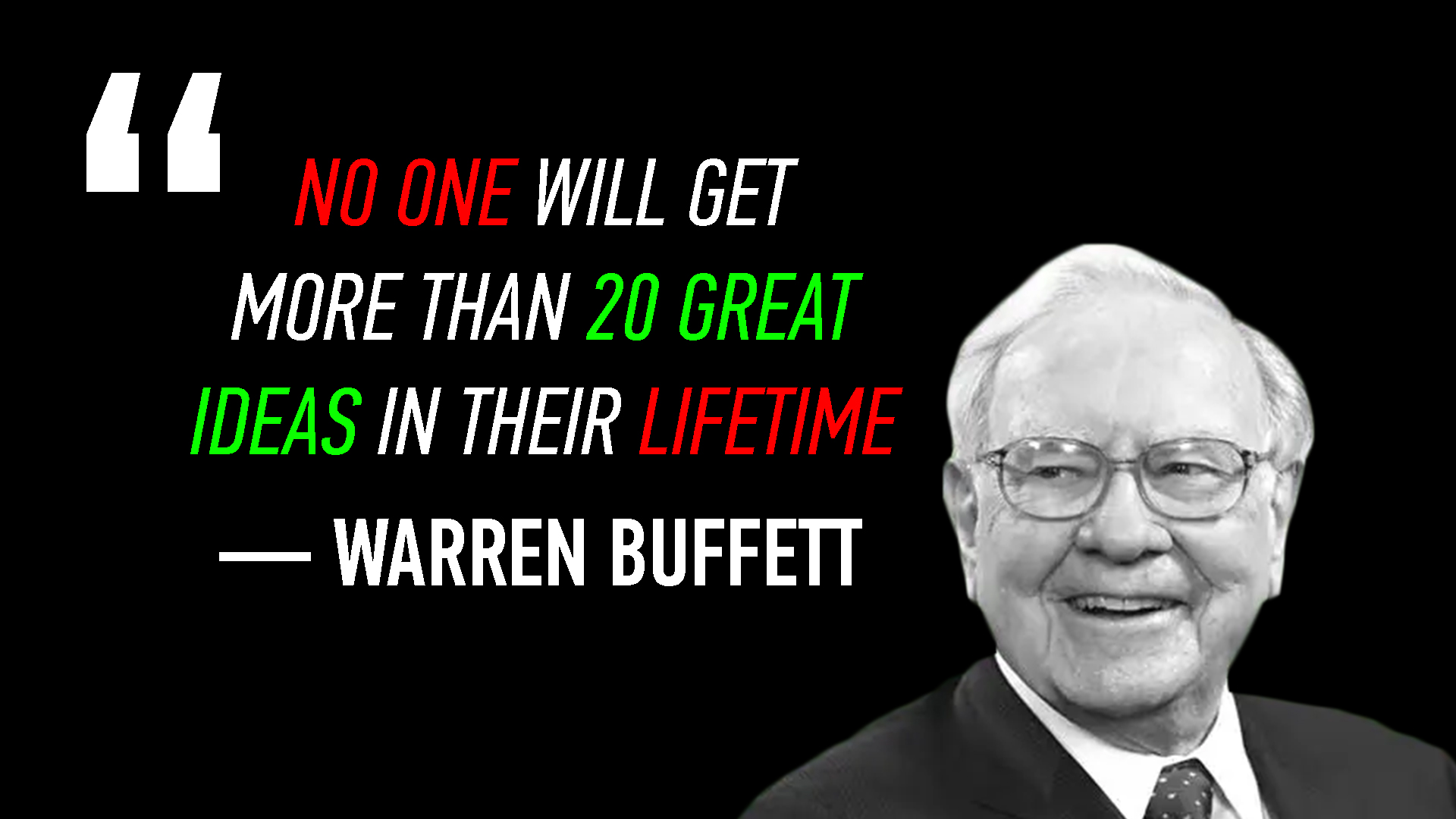
When the Buffett part of Berkshire is over—when somebody looks at whatever the end result is—my guess is that if you take out the best 15 decisions, it would not be much of a record.
— Charlie Munger
I'll confirm that. [...] No one will get more than 20 great ideas in their lifetime....
— Warren Buffett
The Most Uncomfortable Truth in Investing
Most people believe that successful investing requires constant action—monitoring markets, rebalancing portfolios, chasing trends, and "actively managing risk." Wall Street rewards this belief. Brokers profit from trading volume. Business schools celebrate "dynamic portfolio management." The financial media breathlessly reports every market wiggle as if it demands an immediate response.
But Warren Buffett and Charlie Munger—the two greatest investors of our era—built Berkshire Hathaway's $800+ billion empire on the opposite philosophy: The less you do, the better you'll do.
No one will get more than 20 great ideas in their lifetime
This insight flies in the face of everything modern culture teaches. We are told to "hustle," to "stay active," to "make moves." Yet Buffett and Munger's track record proves that restraint, patience, and the discipline to wait for the few decisions that actually matter is what separates wealth-building from wealth-destroying.
The 20-Punch Card: Buffett's Thought Experiment
In speeches to business schools, Warren Buffett often presents students with a radical proposal:
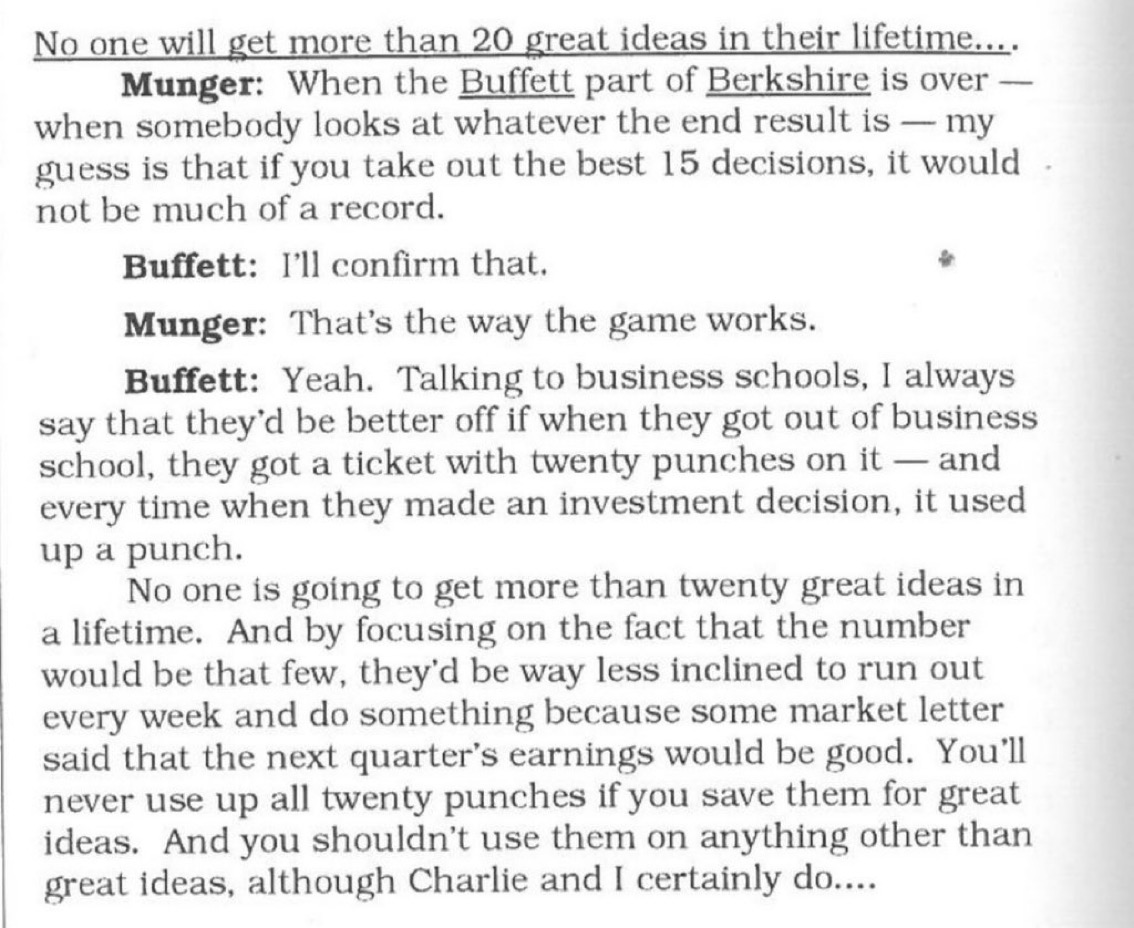
"Imagine you got a ticket with only twenty punches on it when you graduated from business school. Every time you made an investment decision, it used up a punch. What would you do differently?"
The premise is simple but transformative. If you knew you could only make 20 investment decisions in your entire lifetime, would you waste a punch chasing the latest meme stock because a Reddit forum said "this is the next GameStop"? Would you burn a slot on a company you barely understand because your friend at work mentioned it's "going to the moon"?
Of course not. You would become obsessively selective. You would wait for the fat pitch—the opportunity so obvious, so mispriced, that refusing to swing would be irrational. You would research like your life depended on it. You would only invest when you had genuine conviction, not just a hunch or FOMO.
As Buffett notes: "You'll never use up all twenty punches if you save them for great ideas. And you shouldn't use them on anything other than great ideas, although Charlie and I certainly do..."
Charlie Munger Confirms the Math
When Buffett proposed this 20-punch card exercise, Charlie Munger responded with a statement that should be tattooed on every investor's brain:
"When the Buffett part of Berkshire is over—when somebody looks at whatever the end result is—my guess is that if you take out the best 15 decisions, it would not be much of a record. That's the way the game works."
Buffett immediately agreed: "I'll confirm that."
Let that sink in. Berkshire Hathaway—one of the most successful investment vehicles in human history—can trace nearly all of its $800+ billion market capitalization to approximately 15 decisions. Not 150. Not 1,500. Fifteen.
These weren't trades. They were lifetime bets on businesses Buffett and Munger understood deeply, purchased at prices so attractive that even conservative estimates of intrinsic value suggested massive upside. These were decisions made with the level of conviction that comes from hundreds of hours of study, not a 5-minute scroll through Yahoo Finance.
Berkshire's "Great 15": The Decisions That Mattered
What were these legendary 15 decisions? While Buffett and Munger don't publish an official list, we can reverse-engineer the core holdings and acquisitions that built Berkshire's empire. Here are the investments that represent those precious "punches":
Company/Investment | Why It Mattered | The Moat | The Result |
|---|---|---|---|
Coca-Cola (1988) | $1.3B investment became $25B+ by 2020s | Global brand, infinite distribution | ~1,900% return |
Apple (2016) | $36B position worth $160B+ today | Ecosystem lock-in, brand loyalty | ~340% return |
American Express (1960s) | Purchased during crisis, held 60+ years | Network effects, premium brand | Multi-thousand percent return |
GEICO (acquired fully 1996) | Built into dominant insurer | Low-cost producer, float advantage | Core pillar of Berkshire |
Burlington Northern (2009) | $34B bet on America's infrastructure | Irreplaceable rail network | Steady cash machine |
See's Candies (1972) | $25M purchase, generated $2B+ cumulative profits | Brand pricing power | 8,000% cumulative return |
Notice a pattern? Every single one of these investments shared three traits:
Understandable Business Model: Buffett and Munger could explain what these companies did in one sentence. No blockchain. No quantum computing. No "disrupting the paradigm."
Durable Competitive Moat: Each company possessed an advantage that couldn't be easily copied—brand loyalty (Coca-Cola), network effects (American Express), irreplaceable infrastructure (Burlington Northern).
Purchased at a Reasonable (or Better) Price: Even the "expensive" purchases like Coca-Cola in 1988 were bought at valuations that, when stress-tested with DCF models, offered compelling upside.
Why Most Investors Fail: The Hyperactivity Trap
If 15 decisions can build an $800 billion empire, why do most investors make 150 decisions a year and end up underperforming the S&P 500?
The answer lies in the toxic combination of three psychological forces:
1. The Illusion of Action Equals Progress
Modern culture worships "hustle." We are conditioned to believe that doing something—anything—is better than doing nothing. This mindset is poison in investing. The stock market rewards patience, not activity. Every trade you make costs money (taxes, spreads, fees), introduces risk (you could be wrong), and burns a precious mental resource (your conviction).
As Buffett notes: "You'll never use up all twenty punches if you save them for great ideas." But most people treat investing like a video game where the goal is to accumulate points (trades), not wealth.
2. FOMO: The Fear of Missing Out
When GameStop rallied 1,500% in 2021, millions of people who had never read a 10-K report suddenly became "investors." They watched Reddit forums explode with screenshots of Lamborghinis and yachts and thought, "I'm being left behind." So they bought at $300, watched it collapse to $40, and learned an expensive lesson: FOMO is not an investment thesis.
The 20-punch card inoculates you against FOMO. If you only have 20 punches, you don't waste one on a meme stock. You wait for opportunities where the upside is so clear, the moat so wide, and the price so attractive that not investing would be the mistake.
3. The Belief That Smart People Trade More
Wall Street has spent billions convincing you that "sophisticated" investors constantly rebalance portfolios, chase hot sectors, and "actively manage risk." The data tells a different story. Study after study shows that the more you trade, the worse you do. Why? Because every time you sell a winner to buy "the next big thing," you pay taxes, reset your compounding clock, and introduce the risk that your new pick is garbage.
Buffett and Munger's genius wasn't complexity—it was simplicity. They found businesses so good that the only rational move was to hold them forever. Coca-Cola. American Express. Apple. These aren't trades. They're lifetime partnerships.
How to Apply the 20-Punch Card Philosophy
You don't need to literally limit yourself to 20 decisions (though you could). The point is to internalize the mindset: Treat every investment as if it's one of only 20 you'll ever make.
Here's how to implement this philosophy in practice:
Step 1: Create Your "Qualified Ideas" List
An idea only becomes "qualified" if it passes three brutal filters:
Can I explain this business to a 10-year-old? (If not, you don't understand it well enough.)
Does it have a moat that will last 10+ years? (Brand, network effects, cost advantage, regulatory barriers—something that makes competition nearly impossible.)
Is the current price attractive relative to intrinsic value? (Margin of safety: buy at 60-70% of fair value.)
If an idea fails any of these filters, it doesn't make the list. Period. This alone will save you from 90% of bad decisions.
Step 2: Wait for Mr. Market's Panic
The market is manic-depressive. Some days it offers you businesses at absurd premiums; other days it practically gives them away. The 20-punch card teaches you to wait for the latter.
In 1988, Coca-Cola had a temporary dip due to fears over "New Coke." Buffett bought aggressively. In 2016, Apple was being written off as "just a phone company" while trading at a P/E of 10. Buffett bought $36 billion worth. In both cases, the business hadn't changed—only the price.
Your job: Maintain a watch list of 5-10 "Wonderful Businesses" you've already researched. When the market panics (2020 COVID crash, 2008 financial crisis, sector-specific selloffs), you already know what to buy. You don't need to scramble; you just execute.
Step 3: Think in Decades, Not Days
Once you use a "punch," commit to holding for at least 5-10 years unless the thesis breaks. Selling because "it's up 30% this year" is not a strategy—it's a reflex. If you bought Coca-Cola in 1988 because you believed in its global moat, why would you sell in 1990 just because you made money? The moat is still there. The cash flows are still growing. Compounding hasn't even started yet.
Buffett's favorite holding period is "forever" because businesses with moats compound intrinsic value over decades. Every time you sell, you interrupt that compounding and trigger taxes. The 20-punch card mindset makes you viscerally feel the cost of selling—you're burning a punch on a new decision, and those are scarce.
Step 4: Embrace Boredom as a Feature, Not a Bug
Investing with the 20-punch card philosophy is boring. There will be months—maybe years—where you do absolutely nothing. You'll watch friends chase AI stocks, crypto, SPACs, whatever the flavor of the month is. They'll brag about 50% gains in a week. You'll sit there, holding your Coca-Cola and American Express, watching slow, steady 10-12% annual returns.
And that's exactly the point. Boring is profitable. Boring lets you sleep at night. Boring compounds at 10% for 30 years and turns $10,000 into $174,000. Exciting usually ends with your portfolio down 70% while you explain to your spouse why you bet the kid's college fund on a meme stock.
The Ultimate 80/20 Rule: Why 3-5 Holdings Can Beat 50
Modern Portfolio Theory (MPT)—the framework taught in every business school—tells you to "diversify" by owning 30-50 stocks to "reduce risk." Charlie Munger called this "dementia." Here's why:
When you own 50 stocks, you own 47 you barely understand. You can't possibly research 50 businesses deeply enough to know their moats, their unit economics, their competitive threats. What happens? You end up with a portfolio that looks like the index—except you paid fees and spent hundreds of hours for the privilege of mediocrity.
Contrast this with Buffett's approach: Berkshire's top 5 holdings represent over 70% of its equity portfolio. Why? Because these are the businesses Buffett and Munger understand so well that they can bet billions on them. Apple alone is nearly half of Berkshire's public stock holdings.
This is the 80/20 rule in action: 80% of your returns will come from 20% of your holdings. So why dilute those winners with 30 mediocre companies you bought because some guru said "diversification is key"?
The Bottom Line: For most investors, a concentrated portfolio of 3-5 "Wonderful Businesses" purchased at fair prices and held for decades will outperform a "diversified" basket of 50 mediocre stocks. The key is conviction, not quantity.
How to Defend Against Temptation: The "No" Checklist
The 20-punch card philosophy requires you to say "no" far more often than you say "yes." To help you resist the siren call of bad ideas, here's a checklist. If any of these apply, the answer is an automatic "no":
"Everyone is talking about this stock." (If everyone knows, it's already priced in.)
"This company is going to disrupt everything." (Disruption is not a moat. Ask the 10,000 dead social media startups.)
"The stock is up 200% this year." (Past performance ≠ future returns. You're buying momentum, not value.)
"I don't fully understand how they make money, but..." (Stop right there. If you can't explain it, you can't invest in it.)
"This is a short-term trade." (You have 20 punches for your lifetime. None of them should be wasted on speculation.)
Every time you're tempted to pull the trigger on a questionable investment, ask yourself: "Would I use one of my 20 lifetime punches on this?" If the answer is anything other than an emphatic "yes," walk away.
The "Lazy Investor" Shortcut: Using One Punch on the S&P 500
Here's a radical thought: What if you used just one of your 20 punches on an S&P 500 index fund and never touched it again?
The S&P 500 has returned approximately 10% annually for over a century. If you simply dollar-cost average into a low-cost index fund (like VOO or SPY) every month for 30 years, you will almost certainly outperform 90% of professional investors, hedge funds, and day traders.
Why does this work? Because the S&P 500 is a collection of great businesses. Apple, Microsoft, Nvidia, Coca-Cola, American Express—they're all in there. You're essentially buying a diversified basket of moat-protected, cash-generating machines without having to analyze individual companies.
The 20-punch card still applies: you're using one punch on a single decision ("I will own the S&P 500"), and then you're done. No rebalancing. No market timing. No panic selling. Just boring, relentless compounding.
This is the path for those who either:
Don't have the time or interest to research individual companies, or
Want to beat the vast majority of investors with the absolute minimum effort.
There's no shame in this strategy. In fact, Buffett himself has stated that for most people, a low-cost S&P 500 index fund is the best investment they'll ever make. It's the ultimate "20-punch card" move: one decision, one lifetime, one outcome—wealth.
Case Study: What Happens When You Ignore the 20-Punch Rule
To drive this lesson home, let's look at the cautionary tale of the "average retail investor" during the 2020-2021 period.
In March 2020, the market crashed due to COVID-19 panic. The S&P 500 dropped 35% in weeks. This was a generational buying opportunity—the kind that occurs maybe 3-4 times in a lifetime. Companies with rock-solid moats (Apple, Microsoft, Visa) were trading at 30-40% discounts.
What did the "20-punch card" investor do? They calmly reviewed their watch list, calculated DCF values, and deployed capital into these proven winners. They used maybe 2-3 punches on lifetime opportunities.
What did the hyperactive retail investor do? They panic-sold everything in March (burning punches 1-10), then bought back in at higher prices in May (punches 11-20), then chased GameStop in January 2021 (punches 21-30), then bought AMC at $60 (punch 31), then rotated into crypto when Dogecoin mooned (punches 32-40), then sold everything again when the meme bubble popped (punches 41-50).
The result? The hyperactive investor's portfolio in 2024 was down 30-50% from its peak. The 20-punch investor's portfolio was up 100-150%, driven by compounding gains in Apple, Microsoft, and other quality businesses purchased during the panic.
Same market. Same opportunities. Opposite outcomes. The difference? Discipline.
The Ultimate Lesson: Inaction as Strategy
The 20-punch card is not about limiting your wealth—it's about maximizing it. By forcing yourself to treat every investment decision as scarce and precious, you naturally filter out mediocrity, noise, and ego. You stop chasing. You stop trading. You stop trying to be clever.
Instead, you focus on what actually builds wealth: finding businesses so good that holding them for decades is the obvious choice, buying them at prices that offer a margin of safety, and then doing the hardest thing in all of investing—nothing.
Munger's confession that Berkshire's success came from "maybe 15 decisions" isn't a bug—it's the whole point. Greatness in investing isn't about making the most moves; it's about making the right moves and having the courage to sit on your hands the rest of the time.
Action Items: How to Start Today
To implement the 20-punch card philosophy starting now:
Create Your Watch List: Identify 5-10 "Wonderful Businesses" you understand deeply. Research them thoroughly. Calculate their Fair Value. Wait for the market to offer them at attractive prices.
Audit Your Current Holdings: Look at your portfolio right now. How many stocks do you own? Can you explain each business model in one sentence? Do you know their moats? If not, you're over-diversified. Consolidate ruthlessly.
Embrace the S&P 500 Default: If you're not ready to pick individual stocks, there's zero shame in index investing. Dollar-cost average into VOO or SPY every month. That's one punch. You're done. You'll beat most professionals.
Practice Saying 'No': The next time someone pitches you on "the next Amazon" or "the AI stock that will 10x," use your mental 20-punch filter. Can you explain it? Does it have a moat? Is it attractively priced? If any answer is 'no,' walk away.
Remember: You are not trying to find 100 good ideas. You are trying to find 3-5 great ideas and bet heavily on them. That's how fortunes are built.
"No one is going to get more than twenty great ideas in a lifetime. And by focusing on the fact that the number would be that few, they'd be way less inclined to run out every week and do something because some market letter said that the next quarter's earnings would be good."
— Warren Buffett
Welcome to the 20-Punch Club. Your first lesson: Do less. Earn more.