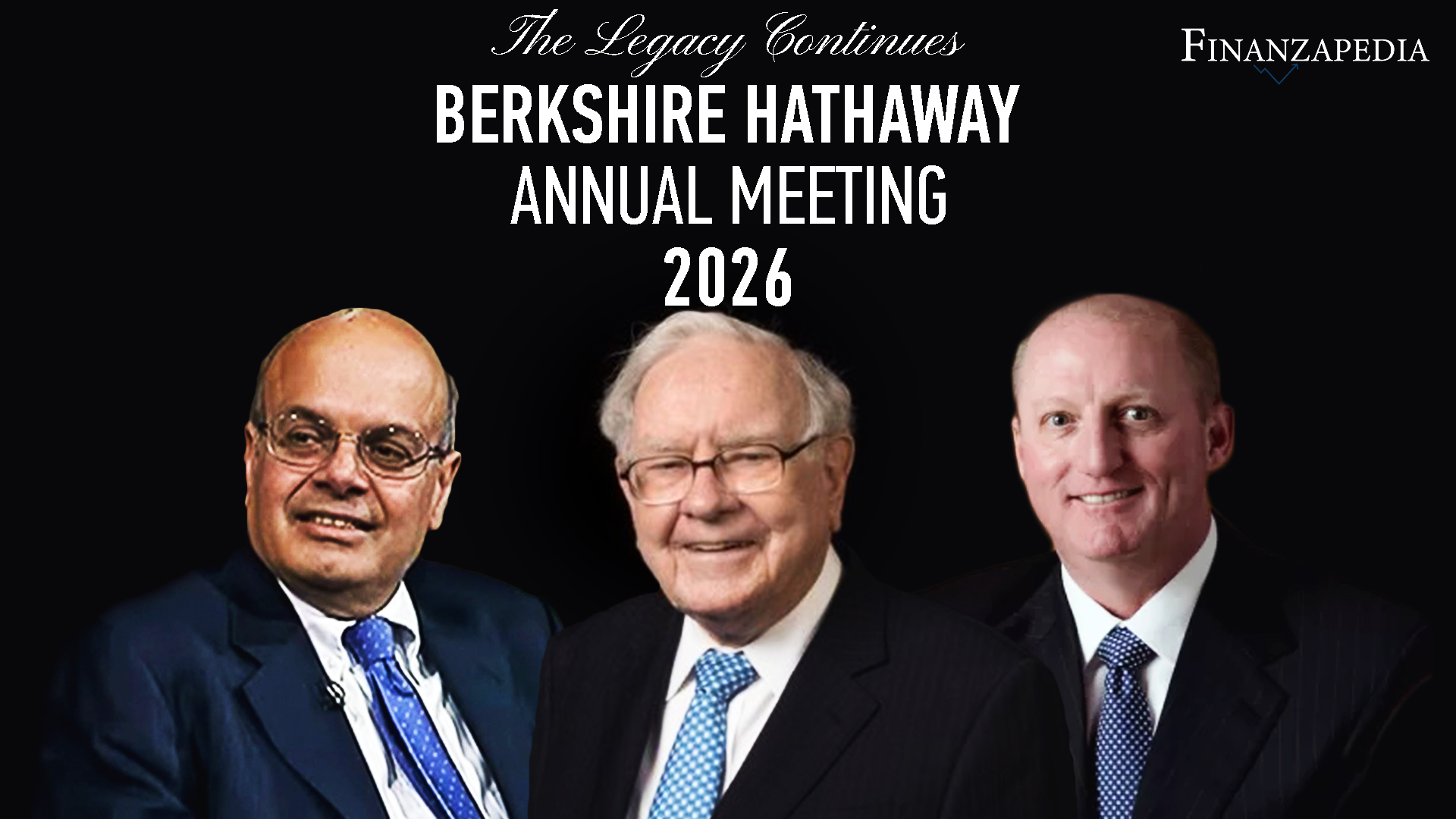
GREG ABEL (CEO, Berkshire Hathaway)
Opening Welcome:
"Good morning and welcome to Omaha. I want to welcome all our owners, our long-term owners, those that have recently become a shareholder. Again, thank you for joining us in Omaha for this for the meeting. Obviously, very excited by this. And I want to also touch on — we have many people here just experiencing it. So just great to be together."
"The first thing I just want to touch on — we had the video, incredible 60 years. The one thing I did note that we've traditionally had was we've often had a movie which included the credits that came with it. And the video — and we'll have a few other videos that I'll touch on later — but we did have an exceptional producer and executive producer and I want to thank her because she wasn't acknowledged: Susie Buffett. Thank you. And then the director who's always done the movies, again did this video and we'll do our company videos that I'll touch on shortly — Brad Underwood. Thank you, Brad."
Session Overview:
"Now, we have a great day planned and it's really all around our owners. It's our culture, but most importantly, this is our owners day, our owners weekend. We have an exceptional group of owners, and we're just passionate to be here. We will communicate a variety of things around Berkshire and our insurance, our operating subsidiaries and Berkshire as a whole, but what we really treasure is the engagement with our owners, our shareholders and the questions that come. So thank you. Really appreciate it."
"Now to touch on this morning, we have three sessions that we'll cover over the morning early afternoon. The first session, there'll be some pleasantries here and then we'll move into a business update. That'll be the first session. As we move into the second session, I'll have Ajit join us here on stage. We'll obviously take any questions. So it'll be a question and answer period. We'll do the traditional rotating between our shareholders and Becky. Becky, thank you for being here. And we'll do the traditional Q&A and then that session will wrap and then we'll move to a third session that will have Katie Farmer. Katie has been the CEO of BNSF Railway for the past five years. And then we'll also be joined by Adam Johnson who is a 10-year CEO of NetJets but also took on an incremental role recently and we announced that in December. Adam took on the consumer products group, services and retailing group. So we'll have them join us for the third session. Again, the traditional question and answer period."
"The only thing that I would say — this is also a little bit incremental or different from past meetings. Throughout this morning, we'll have three different videos associated with operating companies. The first one will be from Geico. Nancy Pierce, who's the CEO of GEICO, long-term veteran and wealth of experience with Geico. She's over in the manager section. She'll narrate a video on Geico. And then we'll also have a video on NetJets narrated by Adam and a video narrated by Katie on BNSF the railway. So that'll be incremental."
"Now the fundamental purpose of both having some incremental managers join us on the stage and the videos — we have an exceptional team at Berkshire. The depth of management is very deep. Obviously, we have a number of subsidiaries, but the depth of our team is great. And this is an opportunity through the videos or having incremental leaders on stage. It's an opportunity for you as our owners to both learn more about those businesses, but also about the leaders that lead them. And that will be a format that as we go forward, we'll build on. I.e., we can introduce you to other leaders either on stage or through the videos."
Introducing Directors:
"So let's move to the formalities. Now I'm going to introduce our directors. I'm going to do it alphabetically. So if they could just acknowledge with a wave or however they would like to acknowledge our shareholders, our owners. Start with Howard Buffett. Susie Buffett. Our chairman Warren Buffett."
"Warren, we have a little surprise there for you. If you look up to the right, you'll see a jersey and a number. We are retiring it — worn appropriately. It's number 60 for 60 years as our CEO of Berkshire. Equally, it's being placed beside Charlie's jersey, number 45. Charlie was with Berkshire for 45 years, obviously our vice chairman and a treasured partner of Warren and it's just reflective of a great partnership. Thank you, Warren. I'm happy to report both those jerseys will remain in the rafters for the years to come."
"Now we'll continue with our directors. Steve Burke, Ken Chanel, Chris Davis — our lead director. And I'll just add a point here because this is Sue's 20th year as a director of Berkshire. Thank you for being our lead director and all you do. Sue Decker. Charlotte Gim. Ajit Jain — I would just add, relative to Ajit, obviously been our vice chairman of insurance for nine years. I had many years to be his co-chairman. But one thing I just want to touch on — Ajit joined Berkshire in 1986. So not only is he a director, he's just been really the architect of our insurance business. So again, thank you, Ajit. Tom Murphy Jr. Wally Whites. Mel Whitmer."
Personal Reflection on Transition:
"Now I think my eyes have adjusted a bit to the lights and everyone out there. And I have to tell a little bit of a story here because when Warren announced the transition last year and I was sitting here and couldn't have been more proud, but I don't mind sharing — the first thing that flashed through my mind was, geez, we've already booked this arena and I knew the directors would be here and I knew I would have some family here, but it's wonderful to all have you here. So thank you."
"Thank you. Now, back to a great tradition. I'm going to throw the mic over to Warren. Warren, thank you."
After Warren and Tim Cook's remarks:
"Tim, on behalf of our shareholders and owners here, we echo everything Warren said and I would add one thing — you've truly been a global ambassador around the world for American business. Thank you."
"And Warren, thank you for taking the mic there. I am reminded I have a cherry coke here in your honor, peanut brittle in Charlie's honor, and that seat remains open. Thank you, Warren."
Berkshire's Anthem Introduction:
"Now, we'll move to a little more — a few more formalities and get into the business update. It really started with the letter to our owners and shareholders at the end of February. And I touched on it in the letter. I highlighted that the first thing as we transitioned, I wrote a letter to our 400,000 employees touching on culture and values. And the purpose of that letter was to highlight that was not going to change. It had never changed in Berkshire under Warren's 60 years — aspects evolved but our culture and values did not change — and that as we did the transition that was not going to change either. It's the bedrock of Berkshire, that culture and values."
"Now one of the values we've often touched on here is integrity. There's no better example of Warren's remarkable demonstration of that when he testified before Congress in 1991 as the chairman and CEO of Salomon Brothers. I like to call it Berkshire's Anthem, but I wanted to make sure we had that opportunity to see the video today. Berkshire's Anthem."
After the 1991 Congressional Testimony video:
"Berkshire's anthem — that's embedded in Berkshire. We send a reminder to our CEOs and employees, our 400,000 employees. And we do remind them of that, including — I ask our CEOs each year, I just sent out a letter again in the first quarter, asking them as they run their business, as they make those daily decisions they make, apply that simple test that Warren highlighted — the newspaper test."
Business Update — Exhibit Hall:
"Now moving to the more formal update on our numbers. We in fine tradition always start with our exhibit hall sales from the exhibit hall yesterday. And the interesting thing is last year was a record as you may guess, but fortunately this year sales were very consistent with 2024. We're basically at 1.5 million in sales, but the point is we'd always love to get to 2 million and we're not there yet. So we've got something to work on. But importantly, what the exhibit hall represents is our businesses showing their products and services and you get to see this great commitment of our leadership team and their passion for Berkshire and their passion for the owners. I was fortunate to spend some time going through the exhibit hall yesterday and that's a wonderful experience because I get to — we're getting the opportunity to engage with all of you as owners. So we treasure the exhibit hall and what a great experience. And I'll just add it's open till 4:00 today and feel free to spend a little money."
Business Update — Insurance:
"Now truly moving to the more formal aspects of the business update. We issued our 10Q this morning and had the related press release. You can see the results and I'll touch on those. I'll start with Berkshire just as a whole. Obviously we have our insurance — as I've referenced, as our heart of Berkshire, it was our foundation. But as we move to the non-insurance businesses, we're really fortunate to have a number of businesses in there, but in their aggregate, they're fundamental and really central to American businesses and American industry and to the American consumer. And when I combine those, it's really the unique opportunity we have to excel across those businesses. And that will continue. It's been our focus and it'll very much continue to be our focus."
"If I start by looking at these results, I'll start with the insurance — total insurance. And I'm starting there because there's a couple really important points to make. You can see in 2026, the first quarter, we're actually up quarter on quarter. And yet in the letter that I sent out just in February, I highlighted that we're unlikely to see stronger results in 2026. But there are some important points here. In 2025, we have an $860 million after-tax charge associated with California wildfires that we insured. The adjustment's not so important. It's just to highlight that the 2026 results and what we're feeling in the insurance industry right now — there's two things. One, our 2026 results do not reflect any catastrophic events. It was a pretty benign period. There were some storms in the northeast part of the United States, but relative to 2025 and past years, very benign."
"And that highlights again that the insurance — our insurance businesses, but the industry as a whole — the pricing, we've talked about that hardening, i.e., can you get the proper premium for risk? It's becoming a more challenging market. What's driving that — when you see a benign environment and I'll touch on further results, another layer — but you start to see competition coming into the industry. They bring a variety of products and forms but it's really they're bringing capital into the industry. So just wanted to really highlight we still see that as a softening market and I'll expand on that."
"Now when we discuss insurance, we have two core objectives at Berkshire: we want to underwrite at a profit — so create a profit for our shareholders — but truly underwrite at a combined ratio, and then the second core objective is to increase our float."
"Now the insurance jargon and the numbers on here — go to the combined ratio on the left and go way over to the right. The 10-year average: 93%. I'll give you a little bit of color here. If we have a $100 premium that comes in associated with a policy, the 93% represents the costs incurred associated with that premium. It can be the cost of writing the premium, the commissions, or the loss reserve we set up. The 7% — i.e., $7 on $100 — is our profit, our operating profit on that premium. And then if I go back to the $93, just roughly $23 of that would be the expenses, the administration of running the business. And that's just an average. It varies across our businesses, it varies across the industry. The other $70 — and this is very important — that's actually what goes down into float."
"So when you see our float growing, we take that $70, it goes into our float and we'll incur premiums against it over the years to come. And when the premium shows up, we pay out against that $70. But if you take a simple small commercial business or personal insurance, that $70 effectively gets paid out likely over a 3 to 4-year period. That premium sits there as float. We earn on it and Warren's referenced it many times. It's a valued part of Berkshire and it's really the opportunity to continue to create value for you as our owners and shareholders. You can see on the float — we've going back to 2015 — it's effectively doubled through 2025. There's a small increase in the current quarter, but I wouldn't — I wanted you to all see it, but it's not the fact it increased — it could have decreased because it's just subject to the payment cycle we're in. The really core and important objective is that we grow it over the long run. And we'll continue to provide those type of updates to you as our owners."
"Now, if I go back up to the underwriting results and you see the combined ratio again, but we'll focus on 2026. Primary and reinsurance — they're both 87%, 89.6%. The amazing thing there is that there's an eight in that number. Our 10-year average is in the 93%. So we're actually realizing more operating insurance income profit there. Again, what's driving that? A very benign environment when you think of the catastrophic environment we insure into. The last time there was a hurricane that hit landfall in the US was 19 months ago. So our quarterly results, our results last year, do not reflect those type of outcomes. Again, that means we have more capital coming into that industry."
"Yes, we like those results. But the reality is as that business — as our insurance business softens and we cannot realize the value we should for the related risk — Ajit and our insurance team across the businesses, we start writing less premium. We still want to write it at an underwriting profit because there's still opportunities there and there's a number of risks we'll insure, but we'll be much more cautious and specifically across the primary and reinsurance businesses."
Business Update — GEICO:
"Now, let's move to GEICO. As I highlighted, we have a new CEO. We're fortunate to have Nancy leading that team. They even have a better combined ratio — 87.3%. That means associated with that business 12% plus operating income coming off of each dollar of premium we write there. Exceptional result. What's driven that is that four or five years ago the GEICO team stepped back and said that they felt they weren't — relative to the risk — getting the proper premium, the proper price for risk. And over the last four years we've seen — we have worked hard, the GEICO team worked hard — to get the proper balance. Across that, that meant our premiums went up for our customers across certain classes of drivers. They worked hard to segment that customer. And by the way, that happened across the auto industry generally speaking — you saw an increase in the overall premium as they managed that underlying risk."
"Again, what's that mean to the industry? What's that mean to Geico? Well, one, there's a lot of folks out there pursuing those customers. Anytime you increase a customer's insurance premium and especially over a period of time — and this is talking about both GEICO and our competitors — listen, people start evaluating and shopping. And we've seen unprecedented shopping activity across the auto space and you see the advertising that's out there. They're pursuing customers and they're pursuing the Geico customers."
"So yes, there's an important balance I want to highlight to all of you. This is what our GEICO team's working on. Yes, we have to get the price to risk right, but there's two other important things we really need to balance. The second piece is we really do want to retain our customers. There's no more valued customer than our Geico customers. Many of you as shareholders and owners of Berkshire are Geico customers. We want to retain all of you. We want to retain every Geico customer. So as we found that right price to risk, the next challenge is making sure we retain our customers. And Nancy and her team have that as a clear objective and they're working hard on that."
"And then the third piece of that balance is to grow GEICO. How do we measure growth in that industry? It's policies in force. And if I touch on what we've experienced as growth in GEICO — if we go back to last quarter 2025 versus this quarter ending March of this year, our policies in force grew by 2%. Now compare that to the number one competitor in our industry, Progressive. They just announced their first quarter results. They grew by 11%. And our team at Geico fully acknowledges, as I said, that balance that they have to find across those three metrics, including growth. It's not going to be easy to just restart the growth engine. We acknowledge that. But they understand the objective and as we go through 2026 and into 2027, two important objectives as I said they have is: let's retain our customers and let's start growing Geico."
Business Update — Tokyo Marine:
"The last thing I'll just touch on the insurance business is Tokyo Marine. I'm not going to expand a lot but other than we announced the transaction in the fourth week of March — a great transaction by Ajit and his team. And it's a strategic transaction in that — and I'm highlighting that because yes there's a financial aspect of it and we're thrilled with that, but it is a long-term strategic partnership. And when Ajit's on stage I'll have him expand on that. Well done, Ajit. Thank you to you and your team. A great transaction for Berkshire."
Business Update — BNSF:
"Now we'll move to our non-insurance businesses. I'll start with BNSF. As I've highlighted, a number of our non-insurance businesses provide critical products and services. BNSF is a great example of that. 32,500 miles of track in the west moving core products for a number of customers that touch every industry in the US. You'll see the results — some improvement there. But what we really want to highlight today, and Katie will be joining me on stage and she'll touch on this, is that we have a lot of work we know to do at BNSF. We have a great group of employees who have been working very hard — boots on the ground."
"So you've heard me talk in the past that we have to work hard in our yards and work on how we can move our cars quicker and meet our customers' expectations. And we're doing a very good job on the customer service side, but we've recognized we've got to get better operationally. Our team has also been very focused on what resources do we have — do we have too many locomotives? Because actually too many locomotives — it sounds counterintuitive — but can be a problem. You're just not as efficient, but the congestion and everything comes with it. So our team's been very focused on that and then how do we best use our employees? Well, that's something our team's working hard on, but we're working hard to become more efficient and more effective. But we also have to very much recognize where we are versus our industry peers."
"This is the six class-one railroads that operate in the US, and we're one of them. And you can see that last year we were fifth out of six. And that's a reality of where we are. But we're also getting better and we are going to get better. We recognize that this performance — our teams have worked hard but there's a lot of room for improvement."
"Now the good news is if I look at it in 2025 and what we have here is our operating margin. So the 34.5% you see for Berkshire — that's the operating profit that came back to BNSF associated with its underlying operations. That operating margin improved by 2.5%, 250 basis points. That's a very positive outcome obviously. And by the way, in fairness to our team, that's the work they've been putting in — that was, on a nominal basis, the largest improvement across our five peers. So we're pleased with that, but we know there's a lot of work to be done. If you look at our first quarter results, happy to report that we went from fifth to fourth, but our team would be the first to say there's a lot more to be done."
"And if you look at our overall operating margin there, very consistent with the result last year and the efficiency we've delivered is being maintained and improved versus the quarter of 2025. So again, we see a lot of opportunity here to continue to get better, but to achieve where, say, Union Pacific is as a leader — with an operating margin of 39.5% — we know that's going to require a step change both in how we're operating, but even how we approach our operations."
"An important step that we've identified — we like to identify the gaps and where we can get better — is technology, and we're doing a lot at BNSF. And I'll touch on our other businesses here when I go through technology, but that's where we see a step change or potentially where a few of our peers have gapped out versus how we're using technology."
Technology Transformation:
"I'm going to back up to Geico and then I'll come back to BNSF because it was approximately four years ago I was in a Geico meeting with our management team there and they were discussing this price to risk and segmenting customers and we had our operational team from Geico, the commercial team, but they had the tech team there — and they're often there — and you're looking for some help. But what I heard in that discussion was a clear technology transformation that was happening at GEICO. It was obvious that the technology was going to be a big part of the solution as Geico tackled their certain challenges. And as that meeting wrapped up, I very much wanted to spend more time with the technology team to understand what was driving this. And they were calling it a technology transformation because I could see that it was so applicable to what we were going to do, what we needed to do and what we would pursue across our non-insurance businesses."
"So what is this technology transformation that they described at GEICO? I'll summarize it in a few different ways, but first and foremost, we recognized we were going to become a builder of technology rather than just a buyer of technology. And that meant that instead of — we had a number of systems and we often bought the related applications or software that came with it. And yes, it's a valued application, but it was disconnected from all our systems. Obviously, we didn't have that ability to then use the information, get to the data. And what they started to talk about is simplifying the infrastructure, making sure we would build what we needed ourselves and deliver solutions back to our customers and we would have clear access to the data. All things that make a lot of sense, but a massive challenge and it doesn't happen overnight. And we're still on that journey at GEICO in year five."
"There's no question, but quickly recognized that this could be used across our other businesses. Very fortunate that at GEICO they had put their leadership team in place to drive forward this transformation. And the most senior leader then came from GEICO and joined our non-insurance operations, took on a senior leadership role helping us with the technology transformation at Berkshire Hathaway Energy and then also as a senior technology officer at BNSF."
"So we started down that journey and one of the first things you have to do is say, okay, we need a different resource base. So now we're hiring engineers, we hire developers in our technology group that help us start to build the solutions we need for these businesses, and it's going beyond GEICO now. And we still have our valued employees there and they may be retraining or transitioning to other roles, but the reality is we need less people managing the applications and the software and more people building outcomes that our businesses need."
"Now, when I asked our team, 'Well, how does AI fit into this — artificial intelligence?' What's actually a big piece of this is because it's effectively what goes on top of a lot of our systems and that's what they're building. They're using AI to build applications. And that's all great but we also know there's certain risks around humanity. There's risks globally and for our country but there's also risk within our businesses. And as I started heading down this path I said, 'Well, okay, how should we think about this? How should we all be comfortable we're approaching this correctly?' And they said, well, we don't really like to call it artificial intelligence — they call it narrow artificial intelligence. And they have three really important principles associated with it."
"The first one was that yes, we're using it and we'll use it with these engineers we have and these highly skilled individuals we brought in, but how are we going to manage it? Well, the first thing was that we still have our employees, our senior management team, involved in implementing the recommendations that we then receive associated with the architecture or the framework they put in place. There may be things that still occur and should occur just like they did within our systems. But as it moves up and the important decisions are being made, there's human involvement. Our managers, our employees are involved and that's part of the governance that's effectively in place."
"The second piece is what they call the safeguard. And the safeguard is very intriguing because right away, of course, we all want good governance. We want that in place. But what's that mean? And our team said, 'Okay, here's how I would describe it: if we ask for an outcome, we want a recommendation or an action and we ask it now, and then half an hour later we ask — do we get the exact same outcome? If we can receive that same outcome, we're effectively — it's the safeguard. We know we're utilizing that application properly.' And importantly, it means we've got a defined data set that we're comfortable with. And I like to call it the constraint. We know we're constraining our data. We know what data we're using and we know what data is coming in. Now when you talk about all the operations that we're focused on, yes, the next day of operations come in and it updates that data set and we may get a different — if we ask the question the day later, we'll get a marginally different answer. It's got new information. But if we ask it, 'Well, if you ignore today's information and just focused on yesterday, do we get the same answer?' Yes. So we call that our safeguard."
"And then the third thing on technology and associated with this narrow AI is it has to be additive to our businesses. We're not going to do AI for the sake of AI. You can spend a lot of money in this area and we need to know what we're trying to achieve and do we see a valued proposition for the businesses. So that's what we call narrow AI."
"And if you see how it's starting to be applied at BNSF, it's incredible. So if I think of BNSF, we have the expansive network I touched on. We have a variety of trains leaving from a variety of points every day. I've touched on it — it can be the intermodal trains of 150 to 200 on our tracks a day which are moving very quickly and often leaving LA to deliver product in Chicago 48 hours later, or it can be — in the last quarter we had more than 750 trains a day moving across that system. There's weather or there's equipment failures. We share our tracks, we allow Amtrak to use them, they can be running on time or running behind schedule. We have to adjust to all of that. And the reality is Katie and her team have a system that's been running for 177 years, but we were not there in how we could use technology to operate that better. And that's what we're using — we've just started down the path — and that's how we know we'll see that step change in our operating performance."
"Now to summarize it all — I want to let you know it's all around operational excellence. We are going to get better at rail, but we're going to use that framework across all of our businesses. They very much will create the framework and then our teams can embrace it if they so choose and we'll help them see the value of it. But there is an opportunity there. And I'll break it down with one last comment around technology. When you think of artificial intelligence, everybody talks about the large language models and okay, they're learning models and there's a lot more to it than I just highlighted. But I summarize it as one thing, and this is why there's an opportunity across all our businesses. Those large language models — I really communicate them as large logic models. We're at this point in time using it to solve logical challenges in our business and what we're trying to do is in a more efficient fashion, i.e., do it more quickly and get to a better answer. So that was a lot in technology but it touches the whole franchise of Berkshire."
Business Update — Energy:
"If I move to energy now and provide an update there — I'm just going to touch on the opportunity first then come to the challenges. Because as I've just discussed, technology is the opportunity in energy. One of the core inputs to all those data centers, hyperscalers associated with artificial intelligence, is energy. Our businesses have that opportunity in front of them at Berkshire Hathaway Energy. And yes, we're pursuing them and we'll do it in a way — I'll touch on it in a way we view as the right approach for both our states and our customers. But I would highlight it's not new to us. If you just go across the river a little bit east, Iowa — we serve just under 50% of that state. If you look at the number of data centers and hyperscalers in that state, it's very significant. And we have four very large hyperscalers, data centers there or builders of them, and ultimately the customers using it. But if I look at our peak load, i.e., the amount of energy being used from those data centers, it's at 8% of their peak load. And the only reason I highlight that 8% is when I hear people in the industry and all the utilities around us — a lot of states — they're talking about this great opportunity, and hopefully in the next 5 years they'll be — from a relatively starting point — wanting to get to 5 to 10%. And we're already at eight and we see opportunities to grow that by 50% over the next 5 years or potentially more."
"But we'll do it in a way — and you're starting to hear more and more of this across the US — we'll do it in a way where we're not going to impact the costs of our other customers. These users — the hyperscalers, the data centers and the users of the energy — they have to bear their full cost. We can't transfer that burden across all our other customers. And that's a principle we've applied across all our utilities from the very early goings when we're building these data centers. And I would highlight I think our team's doing an exceptional job of that. If again you go back to MidAmerican — if you look at their results with all the data centers and hyperscalers and the infrastructure they put in place, their rates are still 45% below the national average. That's just unheard of. It's an exceptional outcome and it just highlights they're doing the right things when they build this infrastructure. And we would highlight we have similar positive outcomes across the rest of our utilities."
"Now I would note one other thing — our gas network or our infrastructure there, our large pipeline company. As they build out all this infrastructure, not just in our utilities but across the US, our pipeline footprint will grow. A lot of it's being built by natural gas and we'll meet that challenge. But here's an interesting point: 15% of the natural gas consumed in the United States is touched by our pipeline network, one of our core assets there. So again, that's the opportunity on the energy side."
"But it's not without its challenges and we've talked about this the past few years. And when I think of the Berkshire Hathaway Energy Group, what's the challenge? It's what I call the regulatory compact. We leave our capital, our owners' capital, Berkshire's capital, in these businesses and often a portion of the earnings that they generate we may reinvest back into those businesses. And for that, we get a very specific set of return. And it's a fair — it's over the long run it's been a very balanced and fair return. But how do you measure that? It's versus the risks we take on in that business. And that's the compact — okay, you're going to pay us X% return and what risks are you asking us to take? And that model has worked very good for a number of years and for centuries. But the problem is it's becoming more stressed. If you think of inflation, if you think of the data center challenges — but I strongly believe we're managing that separately. And then you move to assets that are 60 to 100 years old that are starting to retire and we bring those into the network. The challenge is every day to get more efficient, more effective from the operational side, but as a regulator, as a governor, you're very focused on: I don't want my rates to go up. I don't want to take on more risk. They want to transfer that back to us — and that's the regulatory compact. And unless that exists, if we don't see that balance, we don't deploy our capital back into those businesses or into those utilities and we work hard to maintain it."
"But there's been a very important challenge we've had within that — we've touched on in the past two years — and that's wildfires. Wildfires in the west, very prevalent the last 15-plus years in California. We experienced a very significant wildfire in Oregon in 2020 — a number of wildfires across Oregon, but we being the state but also the company. So there were a number of wildfires across the state. We had certain equipment, certain high winds, we had certain failures with our equipment that contributed to those fires. And associated with that, we fully acknowledged where there was causation and where we were responsible for it. But there was also associated with some of the fires and specifically one fire, a class action lawsuit that was made, had very large claims against our utility there, Pacific Corp."
"And we had to approach it such that we'd resolve all the other matters, but that was a class action. And there was specifically one fire that we strongly felt we weren't responsible for. There was zero causation. There was an Oregon Forestry Department report that said that Pacific Corp did not contribute nor cause the fire. We took a very strong position there that, one, we were not going to put more capital in to fund the entity and these type of risks and these type of obligations. And secondly, we would challenge that liability verdict. And we challenged it."
"It's been a long process, but as owners and shareholders — and this was a very significant event that occurred in this past quarter or occurred in April — we're very fortunate that it was up to the appellate court. They reversed and remanded that liability verdict and said back to ground zero. Start over again. And what they were really saying was that class of customers — who did we actually affect, and where was the causation? That will be revisited and then the related damages."
"Some positive things associated with it. We recover a billion dollars of security we've already posted. The law firms that pursued it are responsible for our costs associated with that period of time — not our litigation costs, but the costs we incurred in posting the bonds or posting that security — that's approaching likely $10 million. So the most important thing is we've reset the stage there and that's very important because we're working hard to get that regulatory compact balanced and getting the right outcome. And we do want to see these utilities move forward and we want to be a very good operator and steward of those assets for our customers."
"The last thing I'll just touch on wildfires — when you think of Pacific Corp, yes, we've addressed that challenge, but to get the right compact, we've worked with Wyoming, Idaho, I've touched on Utah on this stage, to say it requires a judicial system that supports the legislature, the laws in place, but more importantly, we need good legislation that then sets that balance. We've had it across those states and we'll continue to work hard across our other states. So an exceptional outcome and wanted to make sure — there's still a lot to be done there because we're back to the very first base on the legal proceedings."
Business Update — Manufacturing:
"Now, moving to our manufacturing and servicing businesses. This highlights our manufacturing group that represents approximately 70% of that group, and the service and retailing groups. I like to think of when you think of our manufacturing group — we've got three groups there. We have our industrial group, we have our building products group, and we have our consumer products. The consumer products, servicing and retailing — as I've touched on — is now under Adam Johnson. We're fortunate to have Adam as our leader there. He's managing 32 of those companies and we'll have him on stage and we'll expand on that more."
"If I go back to a few of those core manufacturing groups, I'll start with the industrial group. And even when I think of the industrial group, I like to break it down into a couple other groups, but it's a good way to think of our businesses. And that's why I want to share it. Within the industrial group, we have a metals group that is very strong. There's three businesses."
"We have Precision Castparts. It's a business we acquired 10 years ago in 2016. It's run by Mark Donegan, who was the CEO when we acquired the business and he continues to run it today. And as owners and shareholders, we're very fortunate to have Mark in that position. He understands Precision Castparts inside and out. He understands the industry and very much works towards delivering solutions for our customers."
"The second important part of the metals group is a business called IMC — and there is the international metalworking company — and it's really interesting to see that company. They make the tools that remove steel. So they'll take a cylinder of steel, they create the tools and then that gets utilized in a variety of other industries. It can be the aerospace — like a Precision Castparts — or it can be another industry like the auto. If you think of what's happening in the aerospace industry — and this is why Precision Castparts and IMC has such a significant backlog — if we look at what Boeing just announced last quarter, their number of planes that they delivered went up by 11% quarter-on-quarter. That's phenomenal. And they're talking about even doing more. Very similar results at Airbus, and that's who Precision Castparts serves and also often IMC serves that industry. And that's remarkable. But if you hear of the backlog in this space, it's 10 years."
"And I did ask our team the simple question — I go, 'Well, is that because many more people are really flying?' Like, I get it, we're post-COVID and it's building up. And I sort of obviously knew part of the answer, but it's really remarkable why there is that demand. And a lot of us know this, but the reality is to see what's driving it is the efficiency of those planes and engines is so great now that it's better to buy the new plane and retire the old plane. And what you have is this 10-year backlog that we're seeing, a very similar backlog across our metal businesses when you touch on Precision Castparts or IMC."
"Now the third piece of the metals group — and by the way I should just touch on this. We acquired IMC basically 10 years before Precision Castparts. So you go back to a 2006 timeline. We acquired 80% of it. And again, we're very fortunate to have the senior leader there, Jacob Harpaz, who was at the business, the senior leader running it back then and still runs it today. If I look at how Precision Castparts and IMC works together — Precision Castparts is now, if not, but very likely IMC's number one customer. We have them working on joint solutions."
"Now move to that third group. In 2022, we acquired Alleghany and we're fortunate to have that in the family now, a very good addition. But along came with it three non-insurance businesses. There were a variety of other ones that are tucked into the appropriate place in other businesses, but one of them that stood alone was WW Steel. And it was a family-founded company, it had transitioned to Rick Cooper — he's here over in the manager section, he's the CEO. And it's a remarkable business. They create — basically they contribute steel into a variety of core infrastructures. It can be bridges, it can be stadiums, it can be arenas. Their most famous one is the Las Vegas Sphere. And here we bought an insurance company and Warren has touched on this — we sort of had these nice add-ons that I'm not sure we spent a lot of time valuing that side of it, but incredible additions to the Berkshire family. And that really comprises the metals group."
"Now, if we move to the second group — the chemical group we have within the industrial sector. We have three of those. We have Lubrizol going back to 2011. We've touched on that business many times. We then acquired Oxychem last year. Associated with Oxychem, we announced the acquisition and we closed it on January 2nd. Very nice addition. I would say they produce two core commodities — so it's more a commodity chemical business — and they're valued commodities in the industrial sector. But their plants can't be replicated. That would not be easy. So we've got valuable assets."
"And then the third piece of the chemical group is a company called LSPI. And I'm just highlighting because it's a real gem for our owners and shareholders. What that does is it creates a drag reduction agent that allows oil to move through a pipeline. And you can imagine in the environment we're in right now with the fundamental supply and demand imbalance on oil — the more oil that can be moved through those pipelines, and you can't quite double it but you can get darn close. They have an amazing product and obviously in very high demand."
"Now, the last thing I'll just touch on with the industrial group is we have Marmon. Excellent business. And the reason I'm touching on it at the end — it's really amazing because it's the catchall. It touches our rail industry, it touches the energy industry, it touches the metal industry, it touches the chemical industry. It touches all the core industries in the US. And again, a remarkable asset that we have and will continue to create strong value for our owners and shareholders."
"Now, the second piece of the manufacturing group is our building products group. I'm not going to go through all the businesses in there because we have one that is the bellwether and it tells you how the rest of them are doing. That's Clayton Homes. The other businesses — their results follow very much very closely because with Clayton Homes we're building manufactured homes or site-build homes and there's a lot that goes into it and our other companies provide both products to them and across that space. So it could be the insulation, paint, carpet, a variety of other things."
"You look at Clayton's results — if you go to the manufactured side of the business, our results are down on true homes manufactured and sold, down approximately 10%. A little better than the industry average, but that gives you a feel for it. And if you go to the site build, i.e., homes we were home builders — they're down around 5%. And the numbers I've been seeing for the last quarter are probably more like 7% across the industry. And that's obviously driven by where interest rates are and certain other challenges for the consumer."
"But where's the opportunity — and I'll touch on the challenge — where's the opportunity in these businesses and how is Clayton tackling it? It's very much around pursuing the American dream and can we help deliver that? And what I have is a — going to have our team bring up a slide that highlights this is actually a what we call a crossmod home. We have it in the exhibit hall. It got moved in. Had to cut the back off a little bit. So it's not quite the full size if you're comparing it to this. But the reality is this is where the opportunity is within Clayton. We want to deliver on an affordable home to the American consumer."
"This home you're looking at — we thank our Clayton team. Including the lot price, assuming it's in the $40,000 range — and there's a lot of places in America where it's well below that; we recognize some others may be greater — but we can deliver this home, on-site built, two-bedroom family home, very beautiful living space, for $249,000 delivered, including the lot. That's absolutely incredible. That's delivering affordability to the consumer."
"Now, the crossmod — how can we get it to that price? 70% of that home is built in our manufacturing facilities. So those manufacturing homes we produce — we now use it. The last 30% is built by our site builders. They bring the street appeal and all the features that as a homeowner they may want. So it's an exceptional product."
"Now we don't stop there. We still have a very strong culture around the manufactured homes and how can we — what's the extreme on that? Well, if we deliver a single — and this is a 1,000 square feet — if we take it to the manufacturing home and think of a traditional manufactured home — and our team probably won't like it, but it's more the box square box — but what it does create is a home. It can be a two-bedroom with a very nice living space, very well done. Now has a 30-year-plus life on these assets just like this one. And they can get a 30-year mortgage on the crossmod or on a manufactured home now. So that's the quality we're building it to. And we can now do a single manufactured home for just under $35,000. We can deliver it. They still have to get their lot or rent one, but the reality is we're creating homes that people can afford, and that's really where the opportunity is within Clayton. So very proud of what our team's doing there."
"Now lastly, I'm going to move to the service and retailing business. I'm not going to dive into it — in our consumer products business. Again, we'll have Adam here, but when I think of those businesses and Adam's been in that role since December, very much learning the businesses, getting to know the management team — like myself — and how we've always done it. Very focused on capital allocation and the risk, but also very focused on helping the team achieve operational excellence across those businesses."
"Now, if you think of those businesses across those 32 businesses, we have a wide spectrum of where they are in their life cycle. We have some that are still growing and growing very quickly. We have some that are growing at a much smaller pace but still growing. And then we have some that I would call in the more mature cycle, but still creating a valued product to the consumer customer and deploying — producing cash flows that often within those businesses will redeploy across our other businesses. And we'll have that chance to discuss that with Adam."
Balance Sheet Update:
"Now, the last thing I just want to touch on before we move to the second session and I wrap up here — I'm going to move to our balance sheet and activity associated with that. In our first quarter of 2026, we purchased $235 million of Berkshire stock. And we've talked about this often, but when do we purchase stock? It's when our intrinsic value, again conservatively determined, exceeds the current price of our share. And we do that literally. Warren and I will be discussing this on a daily basis — and how do we feel around the overall value. It's not daily, but we think about it daily."
"And the reality is there's a lot of different ways to calculate intrinsic value. It can be a simple premium over book value. You can take book value — because we have everything at a historical cost basis — and try to adjust our various companies. BNSF is recorded on the books at the original price we bought it at versus what's it valued at today. You can go through that exercise. Or if I think of it more as how we would think of businesses when we buy a stock or a full company, we think of it as: we have our balance sheet, we know what our cash is, we know what our US Treasuries are, we know what our equity investments are — they're marked to market. And then we have our operating companies in place. And that's where we have to think about what are the long-term economic prospects of those businesses 5 years, 10 years from now. And then the other important part of that equation is how do we redeploy the capital that comes off of it. And that's really the approach we take to the intrinsic value."
"Now let's move to our balance sheet. The very specific numbers. There's a lot of numbers here. If you look at our cash and US Treasury bills, there's a risk that people use the $397.4 billion as the headline number, because that is our cash and US Treasuries sitting there at the end of March. However — and we don't like these type of adjustments, but it is important to communicate it — there is $17.2 billion of payables associated with the treasuries that are in that total. How does that happen? We bought the treasuries right before the end of March and the payable, i.e., the fact we use our cash to purchase those treasuries, that occurred right after the end of March. So we've got the treasuries up in the $397 and we're still holding the cash. Accordingly, our cash in US Treasury bills net is $380 billion. And yes, it grew by that $7 billion you can see on the slide."
"The other important thing to focus on is our cash and investments at the bottom — the $705.8 billion versus the $708.7 billion at the end of the year. So we're down just under $3 billion. Now what drives that or what's the underlying numbers behind that? We produced close to $10.5 billion of income and related cash flows in the first quarter. We also incurred certain capital expenditures against our businesses — we incur those to either reduce risk in the businesses, to manage those businesses on a sustainable basis, or to pursue growth. That was just under $5 billion. Again, we are involved with our management teams as they decide to deploy that capital and very comfortable with that."
"And then the other piece of the equation in the first quarter was we closed on the Oxychem transaction. $9.5 billion flowed out associated with that. Very pleased with that. Now we did have two transactions last year that we announced. Oxychem, we announced it and closed on it this year. Last year, we announced Bell Labs, a smaller transaction. We're fortunate to have it join our company — Steve Levy and his team. A great group there. It's our — Warren likes to say we finally delivered on Charlie's objective around — we have a rat poison company that we value highly, but it's an exceptional business. But the reality is that's not in that number. We had the Oxychem transaction, which resulted in a little more than a $3 billion decrease in our results."
"So with that, a very wholesome business update. So I appreciate the opportunity to share where our businesses are and where they're going. So thank you."
Introducing Ajit Jain and Tokyo Marine:
"Now, I'm very excited — I'm going to very shortly have Ajit join us on stage and we'll move to the Q&A. But as we transition to that session, we'll have the Geico video narrated by Nancy. Thank you."
(After GEICO video)
"Thank you, Nancy. And to the GEICO team, thank you. We've got an exceptional leader in Nancy. And again, appreciate taking on that senior role. Welcome, Ajit."
"Great to be up here together. As you don't mind, I'll start with — I touched on Tokyo Marine, an exceptional transaction, exceptional relationship I know you've built over many years with the Tokyo Marine management team. But if you could just expand on that strategic transaction and relationship — we'd love to start with that."
(After Ajit's Tokyo Marine explanation)
"Thank you, Ajit. It's an exceptional transaction and a real long-term relationship. Thank you so much. And you know, it's one thing when I think of our also — it reminds me of our five other Japanese companies that we've made investments in. Yes, we like the financial investment, but we also see long-term strategic relationships that can develop across one or all five of them. So fully support and excited by everything you just described. Thank you."
Deep Fake Reveal:
"Now, as you've all picked up, that was a deep fake. But here's the interesting thing — that was done with zero input from Warren. Voice, photo — we were able to obtain that with information that's out there and replicate those actions and that voice. And the reality is that's what we're dealing with when we think of Berkshire and how we have to protect it every day. It can go to deep fakes and they're using it as a way to try to penetrate our business. It can be the cyber attacks, but it's a great reminder for our team because that is a significant risk across Berkshire that we're managing every day — cyber risk — and it's one that we take extremely seriously. I touched on the technology side. We're constantly using technology to protect our businesses. And then we're also trying to use technology to identify it. We've all heard about methods and what's going on there. We're very focused on those risks."
"But Ajit, before we move truly to our first question — and you've touched on this many times — when we think of cyber risk and we ensure it, what's our current approach across our insurance businesses and your thoughts there?"
(After Ajit's cyber response)
"Thank you, Ajit. Let's go to the now truly the Q&A session. Becky, we'll start with you and thank you for being so patient."
Q&A Responses — Session 2:
(After Becky's first question to Ajit on AI)
"I found it interesting — we were together a few weeks ago and Ajit got his team on the phone because we were discussing this exact question, Becky, and AI. Your team immediately went to yes, the cyber risk, which we've already touched on. They then went quickly to the fact that really across the insurance businesses — and it's that building concept that we're very focused on — how do we become more efficient in creating code and managing it? They immediately went to that aspect of it and then as you touched on, becoming more productive, more efficient. And they went as far to say — I thought the example was really good — if we were looking at a risk and we had our traditional underwriters doing it, we might have looked at the five largest risks. And your team highlighted that now we can, in a fairly quick way — yes, we focus on those — but we'll get a very quick view on another using technology. We'll probably look at those other 15 risks and have a strong view on it. Is that fair?"
(After Ajit confirms)
"So using it within the businesses but well aware it's evolving — I think that's a fair way. So thank you. Thanks, Ajit. Thank you. Now formally station one — unless Warren, you're up there again."
Response to Levia (young investor from Irvine/China) — Station 1:
"Sure. I think one of our greatest strengths at Berkshire is patience and being disciplined when it comes to allocating our capital. There will be opportunities that come over time, and for yourself — and it doesn't mean there's not opportunities now — but it doesn't mean you need to deploy all your capital or spend all your money right now. And that's really our approach. We take every day and we recognize we've got a significant asset in our cash and US Treasuries — using ourselves as an example. And I would think of the cash you're holding as that, and that's an asset. It's a great opportunity. You'll feel the moment or feel there's a strong value proposition with an opportunity."
"When do we see those? We've outlined our investment philosophies: we very much have to understand what we're investing in. So we want to have a strong — it can be — you touched on technology and the things you're seeing there and the evolution and how fast it's all changing. I always start with — and I know we always have at Berkshire — do we understand this business? Do we understand the opportunity and more importantly do we understand the risks? Then we want to have a very understandable view of what the economic prospects look like for the next five to ten years. Not the next year — yes, the next year matters — but we're not in that investment for a year. It has to be a long-term view of where that opportunity will go. We take it one piece, one step further: we're going to be in these investments forever. So we think that way and we need to have a strong view on the management team, that they're capable and operate with high integrity. And if we can get to that position — but the most important one being then at the end — the value has to work for us to deploy our capital. We're not anxious to just deploy capital into subpar opportunities. We want to know it meets our principles and then, as I said earlier, we'll act decisively — both quickly and with significant capital."
(To Ajit) > "Anything you'd like to add? No. Thank you, Becky."
Response to Mark Lunder question (Becky) — Session 2:
"Thank you, Becky. So, obviously yes. The many years of operating Berkshire Hathaway Energy and then in the role of vice chairman of non-insurance operations — fortunately, Ajit and I were in those co-roles for the past eight years, nine years now. But that created a very significant opportunity for myself personally to understand those businesses. And as I've already touched on, we have exceptional businesses, exceptional leadership there, but there's still opportunities there. But it does — I'll spend a certain amount of time associated with those businesses and make sure we're allocating our capital properly and we're still thinking about risk across those businesses and encouraging operational excellence. Because listen, having been inside a business — it's easy to look at your internal metrics and convince yourself you're doing okay — and you have to look outside and say, 'Well, what is the customer seeing, feeling? What are our competitors doing?' And I think that's what we can bring on the operational side. I've touched on bringing Adam on or him taking on the incremental role across 32 businesses. He'll bring that great operating knowledge and we have Ajit on the insurance side."
"Now when it comes to the equity portfolio and allocating time — we have significant opportunities there as we look at deploying our capital that's on the balance sheet. And I shared where our cash and US Treasuries were. I would highlight if you think of our equity portfolio as it exists today — I articulated this in the letter — it's in a very concentrated portfolio. And we highlighted that by calling it across the core — but it's what the best name really is — a concentrated portfolio of investments. And we had our core — and you concentrated investments — I highlighted in the letter. We have our Japanese investments. And it's interesting if you then go to the next number of companies where we have positions that are very significant. And I would add that associated with those we may still be acquiring shares or rationalizing what's the right position across that portfolio."
"So the first group, when I highlighted it, was just under $200 billion and remains at that. We have — closer to say $85 billion right now — and then you add in, associated with it — be it the other investments, you have a BofA, a Chevron, a Google, companies like that — there's another $70 billion of investments. And what that highlights is a very significant portion of our total investments are highly concentrated and sit across a limited portfolio. The active management of that is really limited — is really what I'm highlighting. We know those businesses well. We know the management teams. Those are the things that Warren and I would still be absolutely collaborating on and discussing. We don't have to discuss them every day, but if there's something going on across those businesses, we'd be discussing it that week or that month."
"And maybe it's where they're going or what we've learned. The Japanese companies just announced their results in the last 48 hours and that was an active conversation that Warren and I had just around their results and the businesses and what we're seeing there yesterday morning. So those are core, but it doesn't mean we just set them aside or they're concentrated investments. We're constantly aware of them and evaluating them. Ted manages another just under $20 billion of our capital and his responsibilities go far beyond that. He obviously helps us across a variety of our other opportunities or helping us assess risk or capital deployment in our businesses. So we're fortunate to have that."
"But it's a portfolio that's very manageable when you think of the management around it and what's required of it. As we've touched on already, the opportunity to deploy that cash in US Treasuries at the right time is a very significant opportunity — including equities, including what we may see within our operating businesses, and including the insurance side. But when it comes to allocating the time — yes, there's a certain amount of time spent on operations and we'll prioritize that because we see a huge opportunity to continue to improve and close those gaps and operational excellence. We see opportunities within our existing portfolio, but that is either adding to them or rightsizing it and then constantly evaluating what other opportunities are out there, either in total acquiring a company that's private or public. Equally looking at what are the incremental opportunities if we're going to own a piece of a company — and those are evaluated in the same fashion. We look at the economics and really tied to the last answer. Ajit, any thoughts there?"
(After Ajit responds)
"Well said, Ajit. I didn't say it — well said, Warren. No, but obviously we recognize it. And the last thing I just say around that — when you think of our operating companies and I touched on this, we have a very deep bench. We have exceptional operators that understand their business, their industry, their customers. Yes, do we still have opportunities to get better? Yeah, it's continuous improvement and we'll close those gaps. But we have exceptional teams there. And be it myself, Adam — we spend our time making sure we're comfortable how the capital's allocated. Do we understand the risk? And then are we aware of those gaps? So thank you, Becky."
Response to Jackie Han (Station 2) — Capital Allocation:
"Thank you and thank you for attending your ninth shareholder meeting. Yeah, so again when it comes to our capital allocation approach and the long-term approach we've taken, it's very much aligned with our owners and our shareholders that are here. They've taken a very long-term approach around their investment. We're fortunate to have this unique ownership base within our shareholdings. And again, over the long term, there will be significant opportunities for Berkshire — and this is where it's back to the patience and the discipline around capital allocation."
"Do we have any idea what will occur tomorrow, or will that event be three years from now, two years from now? But there will be dislocations in markets that again will allow us to act, and that's where the disciplined approach, knowing our investment philosophy around those activities — and I would add it's not that we don't see exceptional companies out there today that we'd love to own. And I'll be careful because I wouldn't want to say — long term, we'd be happy to own those companies — because there are excellent companies that have excellent management teams that we evaluate. And when you think of the world, it doesn't mean there's multiple handfuls of those type of companies, but they're there. But the price relative to the opportunity, the economic prospects of that company and the related risks — we're not interested in acquiring those companies at that price. And that can be a piece of them or all of them. That doesn't mean that opportunity won't be there in the future. It's what we spend our time preparing for — i.e., one being disciplined, but two being aware of some core opportunities we would treasure or value at the right price. And that really ties back to the discipline."
"And you asked me personally, my plan for patience over maybe quote, action. Again, it aligns to — I took this role and am so fortunate to be in it and work with Ajit and others. But we do it because we love and believe in Berkshire. Warren brought this great commitment to Berkshire, a great understanding of Berkshire and passion — and with that he wanted to create something that was very long-term, including the opportunities it would create. Personally and I know all of us, we bring that same passion and we fully intend to do it consistent with how we've done it in the past. So thank you."
On Hormuz insurance question:
"Ajit, I like your Charlie answer. Obviously some thought has gone into that because there's a lot of dynamics there."
Response to Josh (Station 3) — Circle of Competence:
"Thank you. Yeah, as far as managing the existing portfolio and what's in that — that portfolio as you touched on was put together by Warren, but it is a group of companies that Warren understands thoroughly. And I would be very comfortable that I understand the businesses, the economic prospects of those businesses. So that's why when I outlined it in the letter, I was really trying to send the message that yes, we're very comfortable with those. We understand it and yes, it's a concentrated portfolio, but the businesses will evolve and there's risks that may surface. So we'll constantly evaluate it, but it's a portfolio we're very comfortable with."
"And you know, Warren touched on Tim Cook's amazing success with Apple. But Warren and Tim were recently discussing this and they were talking about — Warren didn't invest in it because he saw it as a technology stock. He saw what the product was and how much the individual consumer valued it. And it's a remarkable perspective, but it would be very much a similar perspective that I think many of us would apply. Would, you know — maybe electricity I know a lot — and I know how to make sure something gets generated and how we're going to transfer it and all that. But am I really that interested in how they make the Apple phone? I'll be intrigued by where they make it and some of the risks and challenges around that. But I do fully — and our team, when we talk about it on a more broad basis — listen, we're looking and saying, do we understand the value and why does that product have value? And it's really that value to the consumer."
"I think the unique opportunity we have — and so fortunate — is that Warren comes into the office each day. It's fortunate that we get to discuss potential other opportunities that may be out there, bringing a different set of skill sets. But in the end, we're going to narrow pretty quickly down to: what's the opportunity? Why is it valued? Why does the consumer — whoever is using it, whatever industry it is — what's why will that company and that product endure? And then associated with that, where are the risks? And that pretty much is how Warren approached it and how I approach it. So when it comes to our existing portfolio, yes we'll always be well aware of what we've invested in, but as far as understanding the opportunities and risks within them, very comfortable that we have a strong view in that. Thank you."
(To Ajit) > "Anything there? No. Okay, Becky."
On Ajit's Succession (Becky's question):
"I don't know how I'm supposed to take that. No — both succession — obviously succession's an important topic. And I'll come back to our board. Both relative to Ajit, and I touched on this earlier — Ajit joined Berkshire in 1986 and is the architect of our insurance business, along with obviously Warren's input from Charlie. It's a franchise that's second to none and we couldn't be more proud of it. And the culture and the discipline within it is exceptional."
"Now, I found it really interesting — and when Warren announced the transition last year and Ajit recalled this — the very first thing that happened was we left that meeting and Warren said, let's — to Ajit but then also myself — let's get the insurance managers together, our top five, along with Ajit and with Mark Hamburg, and let's sit down and talk about the business. Let's discuss the culture. And it was a remarkable opportunity for me to expand my knowledge base on the insurance side. And I obviously had been working with Ajit for a number of years and had other board opportunities where I had a wide understanding of it, but then to spend time with Ajit and our team and have Warren's perspectives — it was great. And that was literally the first action Warren took. And what I could see within that group was a very deep group of management experience, insurance experience, and they absolutely had the same values and culture that Ajit has highlighted."
"Now I think when it comes to culture, Ajit touched on it already, which is it is challenging to keep a culture where you maintain that discipline, because as he said, in action — and telling people, you know, take a few months off when they're used to being active — is not easy if they're that type of underwriter or selling product. So that's the delicate balance. But when it comes to — we're fortunate he's got an exceptional group that works with him and also operates a number of our critical subsidiaries. They're deep in both knowledge and talent."
"I would then also highlight our board takes the succession issues very seriously — both with Ajit and myself. We have a plan, they have a plan in place, and they discuss it. So if Ajit were unable to perform in his role today or I was unable to perform, our board knows what action they would take. Ajit."
On Kansas's climate question (Station 4):
"Thank you. I had a very long and extensive answer last year to the question. And it is an important one, but I think it's one we have to recognize. When we have certain companies where we very much operate — and this would be our utilities, it would be our pipelines — we operate as a steward of those assets. We operate as a steward of those assets effectively for our states and for our customers. And whenever we approach resources, for example, that we may own or what we're going to build, it's very much first and foremost: we absolutely need to comply with the current laws that are in place, including the federal laws. So we know what those parameters are and as we see federal law and state law across our many states, the federal law — there are things implemented to reduce the impact on the environment. We're very sensitive to that and our teams are absolutely committed to both complying and absolutely doing it right."
"I would then add that if we're discussing our facilities, for example, across the river in Iowa, we have plans on resources and when we'll retire our coal units potentially and our gas units. That's very much driven by state policy. The state will decide — through their policy, legislature, and through our regulatory processes — how we'll operate, what assets, how long we operate these assets, because in the end it's those customers that bear the cost and bear the risk. And very much we're respectful of that and we're stewards of that. Do we provide input into that process? Absolutely."
"For example, I know I touched on this last year, but if I look at our Iowa utility — this changes every year because of the load growth we've discussed. But if we look at on a 365-day period, approximately 93% of our energy came from renewable energy. That's remarkable. They absolutely lead the nation. And we've done that in a way where we could do it in an affordable way. But yes, we still have our carbon resources there. We still operate our coal plants. We need them to deliver — what I would call protection to the system. It stabilizes it and there's peak times we need it. But do we use them less? Absolutely. But that's a policy our state made many years ago and we provided a lot of input, as I said, and we've deployed the capital to ensure that could be delivered."
"But the reality is, state by state, they'll decide what resources we'll deploy to serve the customers and they'll also provide us input on when we'll retire our units. The real challenge going forward — and it's well beyond Iowa because I think in Iowa we approach it in a very prudent way and we've got one — prudently we're doing it consistent with our state policy, but want to do it in a frugal way. We're trying to do things that we feel are best for our states."
"But the challenge is — when you talk about the hyperscalers and the data centers — there's a lot of pressure on the system. And there'll be — you know, if you look at the amount of gas units purchased — there'll be an incremental amount of carbon units used as we go forward if that's going to be valued, if artificial intelligence and the consumers want that — it's going to put a lot of pressure on the systems and on the type of assets we use. And the industry uses — anything on the insurance side because I know you've gone on the insurance side as far as what do we insure, how do we approach it?"
(After Ajit's response)
"Thank you. Very valid question but very, very proud. I would say literally proud because I think the one thing we've always emphasized across our utilities, across our regulated entities, that would include BNSF — they have to move certain product that has certain risks and dangers around it. We are a carrier of that, we have to — that's an obligation that came with that railroad, just like our utilities. There are certain things we do that are absolutely required. And the key is that we do it consistent with what's required both federally and at the state level and that we're exceptional stewards of the underlying assets. So with that, we're going to move — thank you — and we're going to move to our next session. But let me explain how it's going to play out a little bit."
Session 3 Introduction:
"So we're approaching 11:00. As we transition, we'll move to a NetJets video. Again, just give you some more knowledge on NetJets and Adam Johnson. We'll then take a break. But this is the exciting part — and we're very fortunate Warren agreed to this. At 11:45, Becky and Warren will do an interview backstage. So basically in 45 minutes, if you take a break and then reconvene, we'll have Warren on the large screen. Becky will interview him. As we take the break, there'll be a couple other activities. One, you'll get a three-minute warning before the 11:45. So if you'd like to rejoin us, you'll be able to see it throughout the arena. And then also during the break, we often did commercials during the movies. We'll have those at the 15-minute mark — basically at 11:30, the commercials will play. That'll be a 12-minute reel of our various commercials from our different companies. Be a three-minute warning and then we have the interview with Warren and then we'll recommence the third session. As we recommence that session, we'll have a video from Katie on BNSF. So please enjoy your break. And Becky and Warren, we look forward to your interview. Thank you."
Welcome Back / Session 3 Opening:
"Welcome back. I hope you enjoyed the break. Becky, Warren, thank you for that exceptional interview. Appreciate that. Katie and Adam, great to have you on stage. I would note both the videos were extremely well done in that it gives us a great understanding of your businesses but also you as leaders. And I'm just going to start with a question for each of you and then we'll go back to the question and answer."
"I think, Katie — well, I know you did — you heard me speaking earlier. I talked to our owners and shareholders around our operating performance and where we are. Highlighted we were in fifth of sixth last year. We've now moved to fourth. And we need to see — we also talked about needing significant improvement, a step change. But the one thing I didn't really touch on is — I started talking about getting to that next level. But as you touched on, you have 35,000 employees and to move the organization to look externally and recognize where do we go — how do you take on that challenge?"
(After Katie responds)
"Thank you, Katie. And then Adam — when I was discussing your new role, and thank you for taking on that role, and also retaining your role at NetJets as the CEO there. A lot on your plate and all of us here appreciate that. But it's early going — you've been in the role since December as the president of consumer products and then service and retailing. What are your early observations across the 32 companies and how are you approaching that — talking to the different CEOs?"
(After Adam responds)
"Great. Well, we're very fortunate to have Katie and Adam in these leadership roles. Again, it was very purposeful to have them on stage. We want them to have the opportunity to engage with our owners, our shareholders. And we really do look forward to the question. So thank you for joining us on stage again. Yeah, thank you, Becky — great to have you back. And if you'd like to start, thank you."
Middle East impact response (Becky's question, Session 3):
"Sure. I'll touch on it and then I'll make sure — because it impacts really in a variety of ways all our businesses. But what I'm most proud of are our businesses. We operate these businesses for the long run just like we do for obviously for our shareholders. We take a long-term approach. There's not many days — and I used to joke when I more had Adam's role — there wasn't a day I woke up where the phone wasn't ringing with good news. You knew you were going to have a bit of a challenge and we have that portfolio, but that's okay. We'd be talking and we always worked our way through it and we have a team that would lean in and we'd come through. And we never tried to use that as a reason we couldn't do something or get to the right place."
"And what I've seen associated with obviously the war in Iran and the various conflicts in the Middle East is again a team that is very much taking the approach that that's the situation we're in, we can manage our business, and we very much quickly move to: what's the best solution for our customers? How can we deliver and continue to deliver what we've done to them? And what's their expectations around that? And our teams will work incredibly hard to come up with solutions."
"I touched on LSPI, the drag reduction agent on the pipeline company. They don't usually sell a lot of product into the Middle East as far as moving. It's more a domestic-based product for Canada and the US. When you think of a drag reduction agent on pipelines, literally being cargo planes of that chemical being moved in the Middle East to help free up supply and remove some of that constraint. So there are so many things that go on when they start trying to figure out how to solve the challenge."
"Now what I would say is it doesn't mean there's not immediate impacts to our businesses. If you think of companies in America around the globe, petroleum and natural gas matter — they're such a fundamental input to so many products. And the reality is, if you think — I touched on our chemical group — their input is generally a petroleum product and the output is the various products they produce. Those input costs have effectively doubled in a very short period of time. But again, we'll manage through that and that's the beauty of being part of Berkshire. They know: first, we'll take care of our customer, we'll find the right answer, we'll manage the challenges, and the value creation will be there in the end. So there's some short-term pressure on our chemical businesses. If you looked at their first quarter profits individually, they would be down because or flat to down because they've got some challenges on the input side. But they're delivering what the customer needs and that rebalances over a period of time where our prices will move up pursuant to our contracts. We'll be treated fairly in the end in that they'll reset and then may unwind a little bit slower."
"But the point is — unfortunate situation — and we've got men of service and women of service over there putting themselves at risk and that in itself is scary because a lot of our employees have family involved. But as far as running our businesses, it's really heads down. We'll get through this and we'll keep operating everything for the long run. And again, it includes how we'll operate our assets. We're not going to put the asset at risk to try to get to a short-term outcome because petroleum prices are higher. It's very much continuing to take that long-term perspective. Katie — obviously it can impact demand and what's being brought in on the coast. Are you seeing that or what are your observations?"
(After Katie responds)
"Thank you, Adam. Across your businesses, what are you seeing? What are you feeling?"
(After Adam responds)
"Great. Thank you, Adam, and thank you, Becky, for the question. We'll now move to station five."
Response to Mjab Singh (Station 5) — decentralization and underperformance:
"Great. Thank you. So associated with the letter I wrote to all of you as owners, I highlighted some important values. One of them was our decentralized model. I also touched on risk discipline, capital allocation. And when we think of our businesses, we have an exceptional group of leaders and businesses and yes, they do own their businesses — as Katie touched on it in her video, as Adam's alluded to it and talked about it. There is a great deal of ownership in each of our subsidiaries and that's absolutely how we'll continue to operate and see it as an extremely effective model. They're closest to their customers, they understand what needs to be done, and if they think like an owner we get very good outcomes across the group of companies."
"I would highlight though that with a decentralized model, we do not — and I was one of those, I ran BHE — it's a great set of responsibilities. When I ran it, that autonomy meant you embraced it and there was a great amount of accountability that came with it and sheer pride that you wanted to do things right. We've got a clear set of — when we talk about integrity and how I started it — we have a lot of expectations and that's where both on the integrity side, how they approach managing their business and servicing their customers. And I've said there's a lot of external factors we can observe, but our primary engagement is with them: are they managing the risk, and first and foremost, do they see themselves as that chief risk officer? You've heard us discuss many times. Are they good allocators of capital with the capital they have there? Because even capital — you have to manage your operating expense as well. I view everything — when we're spending money on a capital expenditure, it can be an operating expenditure — you're deploying our shareholders' capital. Are we doing that well? And we focus on that. So that's part of that equation of allocation of capital."
"And the reality is if we're seeing a situation where we're underperforming or we're seeing some potentially poor decisions, that's where we engage and have a discussion. And usually it's relative — and I touched a bit on this with Katie — it's relative to what we see externally and just really trying to understand where our performance gaps are. And then it quickly moves to how — and we don't have the people at corporate to go in and quote, help. So it's not like we send in an army, but there's generally some people within our subsidiaries or maybe someone we know that could help them with that performance gap. Because we do treasure continuous improvement and strongly, as you've heard, believe in operational excellence. And there's, as I've said, room for us to get better. And that's how we would approach the situations where we see the gap and need to close it."
"Katie, maybe you can probably touch on both."
(After Katie's response)
"Thank you. Thank you, Becky. We'll now move to station six."
Response to Amir Rahani (Station 6) — Tokyo Marine / Hockey:
"Yeah, Ajit did an exceptional job of discussing Tokyo Marine and I'll touch on it. But what I teed up a bit in saying it is a strategic relationship less than a financial transaction. Yes, we like the 2.5% investment into Tokyo Marine and that will be a long-term investment. It's the type of investment we put with our other five investments in Japan. We really think of those as forever because it goes beyond the investment and it's very much around the relationships we want to build there and you'll continue to see that."
"Ajit expanded on the underwriting opportunity that we do — jointly participate in their risk and rewards associated with effectively also 2.5% of their book there now. And that's again part of the financial transaction, but there's also a great deal of faith there. As Ajit said, it's an exceptional company and their performance has been remarkable. So we're thrilled to have them. And then the third thing that was touched on was the partnership highlighted a variety of things we'd like the relationship to develop — and that's not defined yet. So we'll continue to let that take its proper form. They're the type of partner that has the same culture, same values as us. So there's little question it's going to be exceptional for many years to come."
"But as far as pursuing an absolute acquisition in insurance or something like that, that'll evolve with time. And that would obviously be the discussions Ajit and the senior team at Tokyo Marine would be having. And if such an opportunity materializes, we'd be thrilled with it."
"Now to the really tough question — Canada versus US in hockey. I did find a way and it can cause a lot of angst in my own family. I remember waking up that morning and Canada was playing the men, but I'd already decided a little bit earlier that when it came to the Canadian men versus the US men, Conor McDavid plays for Edmonton. And therefore, being from Edmonton, I was going to cheer for the Canadian men's team. And I've always followed the US women and I love what a program the US hockey — and how they approach the coaching and the development of the youth. I think they've done a great job there. So I chose to cheer for the US women and it was the perfect outcome for me — so a little selfish in finding that type of outcome."
"I will say Greg and I had an Oilers-Stars bet last year and the losing person had to wear the jersey of the other and I now own Oilers gear. Yeah, Katie owns an Oilers jersey. And unfortunately this year neither of us get to have that bet — they're both on the sidelines very quickly. But thank you for that question. Becky."
On Berkshire divesting / breaking up (Becky's question):
"Yes. So when we think of the question — and I think it's a good one — because we've always highlighted there's certain circumstances that we may not be the best owner of a business. We've touched on if there's labor issues that we cannot resolve. I would take it to the point further — in my letter I touched on if there's reputational risks that we're not willing to ever have our owners or shareholders or Berkshire experience, and that we have to maybe — the business has evolved, the customers have evolved — but if there's that type of situation, then that company does not belong in the Berkshire family. And it may be a fine business that can be owned by someone else, but it may mean we don't own it."
"I would then take it a little bit further. We've often talked that if we have a business that is unsustainable and no longer generating operating cash for our shareholders, we have to make some serious decisions around that. If there's someone else who could operate it and make it be more successful both for the customer and for our employees, then we have to consider that. Otherwise that business is unfortunately in a place where we can't just fund it and experience losses. We would wind it down over a period of time but we'd look for a better solution for our customers and employees. So that's always been — at least from my perspective — how we'll continue to do it."
"I would say we're taking the obligation in making sure capital's properly deployed very seriously. I touched on the regulatory compact in energy — that has to exist and we have to get a fair return. We have a situation where we've actually announced we're selling a portion of Pacific Corp, our Washington state utility. And that's really a function of the fact that we have a multi-state process in Pacific Corp — there's six different states and each customer is impacted in different ways. And I've already said we very much focus on what's the needs of each state and how can we best service them. And unfortunately we were in a situation in Washington where they clearly had policy they wanted from Pacific Corp and it was having a significant impact on the costs of our other states. And as much as we would have liked to see what we call a multi-state compact, i.e., how do they balance all that? It wasn't occurring and our other states were bearing costs that they felt were not theirs, that were being imposed by another state. So we consciously said this isn't working for the six states. The one state who had very specific policies and wanted them implemented — we chose to exit. We found a very good purchaser who very much supported and could implement what was required at that state. So there we have evolved and it's a situation where it just didn't make sense for Berkshire to be an owner of that asset, or our owners to be an owner of that asset. And it'll be, I believe, a better outcome for the state and for their customers."
"So there are those situations where we would divest. And we will always approach things — when we buy something it's forever. When we acquire a utility we tell the regulators it's forever. But it has to be a relationship that works and if it's broken we'll find a better path both for the company, the employees, customers and obviously for Berkshire."
"Yeah, Kate — there's a second part of that question though that gets at: is there a point where some of the parts — is there a point where it doesn't make sense for Berkshire to be a conglomerate, where you would break up the company?"
"Yeah. So to the second part of the question — absolutely not. We are a conglomerate. But we are an efficient conglomerate. We don't have layers of management. We don't have a bunch of committees telling our businesses how to run, how they're going to manage their customer relationships. We try to at the odd time create frameworks so there's value shared across the businesses, so they're aware of what our other businesses are doing and technologies. That's one of them. We like our framework now — we think it's become very effective across three of our businesses. Of course we want them to understand it but we don't create layers."
"I remember when Adam took on the role I nicely said, you know, there'll be no corporate group supporting you either in Omaha or amongst your own team. He's got folks in NetJets and they always step up and take more responsibility including when I was in the vice chairman role. But the one thing we don't do is create layers of bureaucracy or other decision trees around it. And I think so many conglomerates end up with layers and layers of costs that don't add value to the overall corporation."
"I'm even careful when I talk about our metals group and our chemicals group because they're a group in — call it maybe in my vision — I see similar opportunities. I want them to work together but they don't have a corporate group on top of them or anybody directing them on what to do. They find ways to work together because they can have the same challenges, can have the same customers."
"So we see our conglomerate structure working without the bureaucracy and bloated costs. We see a great opportunity to continue to move capital across those different groups in a very tax-efficient way. Other people can't say that. I want to move capital — BNSF's a great example. Yes, they have strong operating results and they're in a cycle in their business cycle right now where there's a certain amount of capital we have to deploy into it, but we also receive substantial dividends from BNSF on an annual basis. We can take that capital and decide — is it needed in a different operating business? Or do we see opportunities in equities? And if we don't see those opportunities, we're not happy but — we understand the logical home right now is US Treasuries. We think that's a good asset. We prefer to see that deployed in a different fashion, yes, when the opportunity presents itself. But it allows us to really move that capital across the group."
"So I actually — the answer to the conglomerate is: yes, we understand we're one. We see it operates very effectively and we do not see ourselves divesting of subsidiaries for that reason or ever breaking off a group. Thank you."
Response to Lori Wong (Station 7) — Framework for assessing investments:
"So, I'll start with the important part of that question. As far as how Warren thought about it, how Berkshire thought around approaching investments — our margin of safety around investments and how we approach it — we're absolutely aligned there. And that starts with our culture and values and how we've approached everything over the years. So if I go back to looking at opportunities in energy — it may have been an acquisition or we're deploying significant capital — it quickly went to: yes, we understood the opportunity, but Warren and I'd want to have this conversation around where's the risk and do we really understand the risk associated with this."
"And I have a really great example. We were acquiring NV Energy — had the opportunity to acquire it and Warren was actually coming back from China and had been over there and I was waiting for him to arrive and land in Seattle and give him an update that we had this potential opportunity. And I very much knew the opportunity and what the value proposition was. I'd clearly had three significant risks in my mind that I was anxious to discuss with Warren. And Warren landed and I had a short presentation — I'm asking him to just give me a call, it was literally one page — just to really trigger it: can we have this conversation? And the immediate conversation we had was, yeah, the economics — you couldn't agree more, understood them. Went right to the biggest risk. And I was just getting ready to walk him through the two or three risks I'd seen and wanted to make sure we understood it and were comfortable and wanted his input. And the risk was fundamentally rooftop solar and how would it disrupt that business and disrupt our customer."
"We discussed it. We understood it was a challenge. I remember saying to Warren, well, that's part of the reason I'm sure we have this opportunity to acquire this public company — that there is a certain amount of risk. And the public and the board and the management team had decided that they didn't see the same opportunity we did. But Warren went right to it. It was all around the risk. And that risk did surface 12 months later, 18 months. We managed our way through it. Our team did a great job. But so I don't see there being incremental margins or we think of risk differently. We think of them in the Berkshire mindset that we're going to understand the economic prospects of this opportunity. And as I said, we really go to that 10-year window potentially and say, what does the business look like 10 years from now? Is there enough safety margin 10 years from now? If we don't understand what that looks like 10 years from now — I know Warren would say this and I would say it — then we don't do it. There's no safety margin. Or maybe we can adjust some numbers or there'll be synergies or something — we have to have a vision of what that's going to feel like and look like. And that really is how we approach it."
"Now touching on technology companies — we are not going to ever say, geez, this is a specific sector for us or we need to be in it. If there's something in the technology sector or in that group of companies and we understand one of those companies — to understand again what their opportunities are and what we view as the economic prospects for it and we have an understanding of what those risks are — that doesn't preclude us just because it's in a technology sector. But it would start back to the fundamentals: do we understand it, both the opportunities and the risks? And then is it fairly valued relative to that? And that's always going to be the approach. So thank you for your excellent question."
On 'Who will be Greg's Charlie?' — final question:
"And there they are a reason why they're in the rafters together. That was an incredible partnership and one that you can't replicate. But what I would start with is that we're very fortunate to still have Warren as our chairman and that's very important and it makes for an excellent transition."
"I have an exceptional board of directors that I'm comfortable reaching out to any of them individually, depending on the circumstances and either the risk we're dealing with or an opportunity that may be present in any of our businesses or one that may be coming our way. So we're fortunate to have that exceptional group in place."
"And then it really comes back to our team that's in place. And I said this when I was answering Warren from Omaha — we want Berkshire to endure and that means yes I want to lead Berkshire and I'll be a strong leader. I strongly believe that and I'll take Berkshire for it. But it will be — you always need a single leader and I think we strongly understand that. But you surround yourself with great people and they're already here. I've been fortunate on the non-insurance operation to operate with Adam's 32 and the 18 that I still get to interact with a lot. Those 50 — including Adam and Katie — obviously have an exceptional working relationship with Ajit. And I'd seek counsel regularly. Even as vice chairmen, we would constantly have a conversation — Ajit may be making an insurance decision or I was making a decision around one of our non-operating businesses and the first thing we'd cross check is how does it impact your group? So I have an amazing relationship and someone I immensely value the input from."
"And then across our CEOs we're so fortunate to have a great group that I would reach out to any of them on a specific circumstance and ask them for their input. And I generally know where they've dealt with a challenge or a significant opportunity and I'd be the first to seek it out and say, 'Let's talk about it and figure out our path forward.' And it may be that it was someone on their team that really dealt with it and then I'd want to be talking to their team. So fortunately, because of Berkshire and the way we're created — again it is a unique structure — but we have an immense amount of resources around us. And then we have our team in Omaha who has supported Warren for all those years. They're remarkable folks. There's not a lot of them, but they are good and they're exceptional and we're fortunate to have them as part of the team. So Berkshire will endure and will endure as a team but clearly with leadership. So thank you, Becky, for that last question. Thank you."
Closing Remarks:
"So, as we wrap up today — obviously I can't help but thank everyone for joining us this morning and early afternoon, both as our long-term shareholders or those that are our newer shareholders and all again all of you that came for the experience. It's greatly appreciated. We enjoy this engagement. It all comes together because there's an individual Warren has highlighted in the past who pulls together the exhibit hall, pulls together everything here. I'd like to acknowledge her — Melissa Shapiro. Thank you."
"And then the light was over on that table. But we do have — and we made this announcement in December — our longstanding CFO Mark Hamburg is retiring in June of this year. We're very fortunate that he will then stay on for an incremental year as an adviser to our incoming CFO and as a personal friend and adviser to myself. We'll have Mark's knowledge resource — and it's immense when it comes to Berkshire."
"Mark has been our CFO for 34 years. It's not this June, the following June when he truly retires — it'll be 40 years with Berkshire. And it's been such an incredible career and he wears so many hats in this organization. I mean, he's helping Melissa — Melissa's organizing and doing all, but when she has a question she went to Mark to look for the answer around the annual meeting. He's our corporate secretary. I like to say — to replace Mark, we hired a CFO but we also hired a general counsel. It took two to replace him. And more than that. So Mark, thank you for your incredible contributions to Berkshire. Warren has highlighted those and I can only echo all that. Thank you so much."
"Now, lastly, again, thank you for this remarkable experience for all of us at Berkshire. We treasure what we call Owner's Day — that opportunity to communicate around what's going on in Berkshire because we're so proud of it, absolutely committed to it and passionately believe in Berkshire. But equally the engagement of all of you throughout the day yesterday into this afternoon is just greatly appreciated. Thank you and look forward to seeing you next May. Thank you."
WARREN BUFFETT (Chairman, Berkshire Hathaway)
On the leadership transition:
"Yeah. This is not my show today, but there are two anniversaries that we're kind of celebrating today. One is the fact that the board has had what I will generously call a refreshment, which they voted on — and you couldn't have made a better decision. They did it unanimously. It surprised all the board when I announced them last year, except for Susie. And that's been 100% successful. Greg is doing everything I did and then some and he's doing it better in all cases. And he's got — he's the right person. So that decision we score 100% on."
On Apple:
"But there's another anniversary today that I'd like to spend just a minute telling you about, because about 10 years ago, we made a commitment to essentially move 10% of the resources of Berkshire Hathaway. We turned it over to another person who was not that well known at the time. And we did that by spending roughly $35 billion buying stock in Apple Corp. And we were going to have that under the management — we're turning that money over to the management essentially of Apple to make Berkshire look good and without any work by us, which is our preferred way of operating."
"And I would like to report that 10 years later several things are happening. One is the $35 billion — counting dividends, realized appreciation, unrealized appreciation — but that has turned into $185 billion, tax — and I didn't have to do a damn thing. I mean, so it's — you know, we're very big around here on having other people do the work and collecting the money. But that has been a success. And we do look at marketable securities as being businesses. That doesn't mean we hold all of them forever, but we still — our largest holding is Apple."
"And Apple has a very interesting history that some of you may be familiar with. But one item is they're observing an anniversary themselves. I think just within the last week or so they celebrated their 50th anniversary. And you know, 50 years seems like a long time but Apple seems like a very new company. And when Tim Cook went into the top position at Apple, he succeeded — allegedly. And you know, Steve Jobs was — everybody in America knew his name and not many people knew Tim's name."
"And Apple had had this roller coaster experience where the two Steves had started in a garage or something 50 years earlier and then — I'm not sure how many of you know this — but Steve was thrown out for a while. He came back in. He did these marvelous things in terms of developing products. And then he had an untimely death and everybody said, 'Who's going to manage Apple when Steve Jobs isn't around?' And probably just a very few percentage points of American investors had even heard of Tim Cook."
"And we, in effect — Tim took over about 14 years ago when Steve died. But when we made our investment and turned over 10% of the resources of Berkshire — we were turning it over to Tim. And as I say, he has turned that into $185 billion or something pre-tax, which we won't bother to compare to our record with. And but Tim has announced that he's retiring as well. That's an announcement that's just been made in the last couple of years. And so I think it's appropriate if Tim would take a bow and our shareholders would say thanks to him. That's Tim — right by me."
"How would you like to step into the shoes of Steve and come through with his record? I mean, it's one of the miracles of American business management. And so anyway, thank you, Tim. And I'm going to turn things back to Greg and we'll go to the meeting."
As 'Warren from Omaha' (Deep Fake — later revealed by Greg):
"Hi, my name is Warren. Warren from Omaha. I've recently undergone — let's call it a significant change in role — and I have, well, let's just say a not insignificant portion of my net worth tied up in Berkshire stock. Now Greg, I've been watching this company for a while — a long time, a very long time — and I've been telling people that I have no intention of selling a single share, not one. So my question is a simple one. I'm 95 years old. I've got nothing but time and cherry coke and I want to know — just so I have something to tell my fellow shareholders — why should they hold their Berkshire shares for the long term?"
"Anyway, Greg, take it from here."
(After Greg's answer) "Anyway, Greg, I'll let you take it from here. I've got a few things on my plate. Actually, excuse me. I need to take this. Someone may want to sell me their business. I hope it's an elephant."
AJIT JAIN (Vice Chairman, Insurance Operations)
On Tokyo Marine:
"Thank you. Tokyo Marine and Fire is the largest non-life insurance company in Japan. They've been doing business for more than 100-odd years and are clearly regarded as a blue chip company in the international arena altogether. They're clearly number one in Japan. Every insurance company would like to be associated with them. They have a very, very high reputation in Japan and globally as well."
"We being in the insurance business for the last — God knows how many years — we've tried year after year to try and get a relationship going with Tokyo Marine and Fire. It has not been easy because one of the things we bring to the business is a capital partner and Tokyo Marine were cash-rich and they really never needed capital in a big way. They have been expanding in Japan. Now given the limited growth in Japan, they've looked overseas and over these last 8, 10 years they've really got most of the low-hanging fruit overseas that they would like to get. Nevertheless, they are keen and they are hungry for business elsewhere outside Japan. And last year we got a chance to spend some time with them and talk to them in very general terms about what the two of us could be doing and should be doing with each other."
"After that initial conversation, which probably took place nearly a year ago, things moved fairly quickly. So to get to the bottom line — in March we finally announced a transaction with them. That transaction has three legs to it. I'll describe to you each one of them and that'll give you an idea of what the relationship is right now — and we've got a long way to go of course."
"Firstly, we bought some stock in the company — just a simple transaction. We wrote a check for $1.8 billion US and we got 2.5% of the stock of Tokyo Marine and Fire. That was one part of the transaction."
"Secondly, they have a good and profitable book of business in terms of what they write in Japan and elsewhere. We took a piece of the business — just that property casualty business that they write. And you know, we compensated them for their efforts in getting the business, originating the business and running the business. But we get a slice of their business for several years down the road."
"And the third piece was a sort of strategic agreement between the two of us. It is not spelled out in a lot of detail and normally I would be very, very concerned about having open-ended strategic transactions. But Tokyo Marine — they are a quality company. In fact, they remind me of the phrase that JP Morgan used, I don't know how many years ago: doing business in a first-class way. And that is Tokyo Marine in the insurance industry. We have a general statement that we'll work with each other. We'll coordinate when it comes to finding opportunities elsewhere, running businesses operationally. And that is something that will evolve over time in terms of who's going to bring what to the party. And I certainly hope this serves as a springboard for both of us to move on to the next plateau."
On cyber risk:
"Okay. So cyber is something we worry about in the insurance operation at two levels. Firstly, there is a huge demand by people in business all over the world who are interested in buying protection against some kind of a cyber incident. We have been slow — consciously we have been slow — in terms of entering that class of business as an underwriter. The reason for that is firstly on cyber I find it very difficult to have some meaningful method to assess and model the aggregation. People will tell you we've got it under control and they'll show you all kinds of models, but nothing that I can really hang my hat on in terms of we really have a good feeling for what the aggregate exposure is. Because any risk we take on, the first question we ask ourselves is: how bad can bad be? And I'm not sure we can answer that question as well as we should."
"The second reason is cyber has been a very popular, fashionable product in these last several years. We have not played in it. Now, as it turns out, there haven't been very many cyber losses. So people who've taken on cyber risk have actually made profits and as a result the premiums that cyber insurance commands has been coming down over time. So we'd hate entering a line of business where prices are coming down. So we sort of sitting on the sidelines, and I'm not sure when, but I'm pretty certain that the day will come when we will have a fairly significant role to play in cyber."
"Secondly, you know, we being a large company are exposed to cyber perils ourselves. We try and do the best we can. I think we are as good as anyone else. Now, cyber insurance is very highly regulated by the regulators and we've been consistently above what the regulations call for. So I think we're doing the best we can, but I cannot be categorical about it."
On AI and human judgment (Becky's question):
"Yeah. So AI also is very fashionable right now. People are jumping into it from the insurance space and from the non-insurance space. And clearly if AI becomes reality as it's being projected then there's no question about it — it'll be a huge game changer. Right now what we are seeing is AI being used as a productivity tool, as a mechanism for reducing labor costs and doing routine, repetitive things. I do not think AI will reach a point where you can make a tradeoff on things like pricing, settling a claim. That is still years away. And you know, I tend to be skeptical. I'll be surprised if AI can solve that problem for you."
On patience and saying no:
"Yeah. You know, insurance much like investing is a game that requires patience and it is very difficult to get people to sit back and do nothing. When I recruit people, my modus operandi — I tell them right up front: your job is to say no. You will get bombarded with deals day in and day out, but your base case is just say no. I said, every now and then you will come across a deal that'll hit you with a 2x4 and it'll be screaming money. That's when you come to me and we'll make a decision whether to do it or not."
"You know, all kidding aside, it is very difficult to sit there and do nothing while everyone else is being wined and dined by brokers and taken to London. So I think the real test of being successful certainly in insurance and therefore investing as well is the ability to say no."
On capital allocation and operating businesses:
"Yeah. I really think capital allocation and operating businesses are two sides of the same coin. And a comment that Warren had made several years ago I think goes a long way — when he made the comment saying that a good capital allocator will make a good operating manager and vice versa."
On Hormuz insurance:
"I mean the short answer is: depends on the price. Yeah, there's a lot of chatter, there's a lot of need. Fortunately there's enough capacity in the insurance world today that would like to write that risk — for no other reason but people are sitting on excess capital and they'd like to find a way to deploy that excess capital. We ourselves have taken a small participation in a program that's being put in place so as to write insurance for the ships in the Strait of Hormuz. We haven't written any deals as yet. It's still being fine-tuned, but if we can get our terms in terms of the underwriting decisions and the fact that the US Navy will escort these ships, we have put a price on which we will be comfortable underwriting that risk. But nothing's happened as yet."
On Ajit's succession and insurance culture:
"Yeah. So in terms of the culture and the underwriting orientation, which is so critical, there are a few simple rules that I've followed over the years and it's come at a cost but I think net net is still a positive. Let me just lay it out in terms of how I think about this issue."
"Firstly, we have a very small number of people who actually get involved in the decision-making. My top three in the operation — forgetting about companies that we acquire — we have been together for 35-plus years now and we've become friends. And the other thing — to minimize any kind of competition among these people and stepping on each other's toes — we have a compensation plan that gives fixed salaries, fixed compensation to the individuals as opposed to having some complex formula that results in they get the upside and Berkshire gets the downside. I try and stay away from that as much as possible. Usually a really a problem with all the compensation plans I've seen."
"And then the other thing that is important is people need to have experienced going through a tough time and the fact that it doesn't penalize them. We insulate them from the ups and downs of the marketplace so that they feel secure and they do the right thing. And yeah, so those are the elements that I think allow us to have a long-term orientation and not get sucked into the latest fashion of the year day and just do stuff for the sake of doing it. Your compensation question — such a critical point."
"Yeah. The compensation thing — having seen all these programs over the years, I remember having mentioned to Warren at some point in time. I said, 'Warren, you give me a compensation plan, I'll game it. You'll not be able to figure it out for years down the road.' And that's the problem, together with the fact that if the employees lose, they want to go back and renegotiate the plan, and if they win, they're happy to walk away with everything. So that's the big challenge."
On the ABCs (in response to Greg's mention):
(Enthusiastically reacts) — Ajit is identified as "biggest fan" of avoiding arrogance, bureaucracy, complacency.
BECKY QUICK (Moderator, CNBC)
First Q&A question (AI and human judgment):
"Thanks, Greg. This first question, Ajit, let's follow up with the AI. This is slightly different though. This comes from Billy D. Ross in Ardsley, New York, who writes: 'In an era of increasingly complex risk models and AI tools, where does human judgment still provide Berkshire a competitive advantage?'"
(Clarifying for Ajit) "Where is human judgment still a competitive advantage for Berkshire when you consider AI tools that are out there?"
Question from Mark Lunder, Miami:
"This question is for Greg, but I think it's important that you take it while Ajit's on stage with you so he can answer some of it too. It comes from Mark Lunder in Miami, who says he's been a Berkshire shareholder for 30 years. He said: 'Greg, given your background as a business operator, which differs from Warren's roots as a public market investor, could you share how you balance your time between overseeing the wholly owned subsidiaries and the $288 billion equity portfolio? Also, does your operator lens change how you evaluate new investment opportunities compared to Warren's historical approach?'"
Question from Mindy Wasserman:
"This question is for Ajit — the writer is Mindy Wasserman. The question is: 'How and when can you offer insurance to ships crossing the Strait of Hormuz?'"
Question re: Ajit's succession:
"This question is for Greg and it comes from Zachary Phelps from Medfield, Massachusetts, who writes: 'Ajit Jain has been described by Warren as irreplaceable. He's helped build one of the greatest insurance operations in history and has been the backbone of Berkshire's underwriting discipline. How are you thinking about succession planning for Ajit and the insurance business? And how do you ensure that the underwriting culture, the insurance moat, is preserved in the next generation of leaders?' And Greg, I'll just add for compression's sake, I did get questions about your succession planning too. So maybe you can add that in there."
Climate question (Station 4) — after Greg's lengthy answer:
(No additional moderator comments on this question beyond introducing it from the station)
Middle East question:
"Okay, this comes from Chris Frerieded in Philadelphia, Pennsylvania, who wants to know: 'How has the current geopolitical situation in the Middle East impacted Berkshire's subsidiaries?'"
Tariff question:
"Okay. This comes from Brian Simpkins in San Diego, California. The question is: 'Has Berkshire Hathaway considered seeking any tariff relief or reimbursement programs for its wholly owned operating businesses exposed to import costs? And how significant is that impact across the portfolio?'"
Breaking up Berkshire (anonymous shareholder):
"This question comes from a shareholder who didn't want to be identified, but it's a variation of a question that I got from several shareholders: 'Is there any future circumstance that you could envision Berkshire divesting businesses or being broken up? If so, what are those circumstances?' The shareholder also writes: 'Note — I don't want this to happen, but it's commonly discussed among followers of the company.'"
(After Greg's extensive first answer) > "Yeah, Greg, there's a second part of that question though that gets at — is there a point where some of the parts — is there a point where it doesn't make sense for Berkshire to be a conglomerate, where you would break up the company?"
Final question:
"Uh, this question comes from Joseph Matas and he said: 'Warren had Charlie's partnership for most of his tenure as CEO, which naturally reduced the risk of subpar investment decisions. Who will serve as the Charlie for Greg?'"
NANCY PIERCE (CEO, GEICO) — via video
"GEICO started out 90 years ago by trying to make things simple and giving a great price and service to customers. And when you think about it, today is exactly the same thing. We're just continuing to try and perfect that and make it a little better every day, a little faster, a little easier."
"I'm Nancy Pierce and I became CEO of Geico in December of 2025. Prior to that, I was the chief operating officer, but I've just had my 40th anniversary with GEICO. I started as a claims associate in 1986 right out of college and I've just had the pleasure over many, many years of working in I think just about every department or every sector that GEICO has. So while I started in claims, I've been in pricing, I've been in product management, I've been in underwriting, I've had an opportunity to run operations in different parts of the country."
"But what really has kept me all these years and what has inspired me — and I think inspires all 30,000 people at GEICO — is every day we're delivering for customers and we're doing something for them. We're saving them money on a product that everybody has to have but maybe you don't necessarily want to use it. But when you do need to use it, that's really the moment of truth. And for us to be able to do that and to do it in a way that saves people money and gives that outstanding customer service — that's what excites me every day. And the reason that we have customers and will continue to grow is just keeping that as our northstar. And if we do that, I think Geico will be very successful over the next 20 years."
"GEICO was founded in 1936 by Leo and Lillian Goodwin, and their idea was to come direct to consumers and to cut out the middleman and to have much better cost and much better service for those customers. So in 1951, Benjamin Graham took an investment in GEICO and of course one of his students was Warren Buffett. And that's when Warren really started to think about GEICO and to deeply try and figure out what we were doing. And he met with the leadership of GEICO and that was one of his first very big investments — his personal investments. And then later he started investing Berkshire Hathaway shares. And by 1996 he owned all of GEICO. From that beginning, we now insure millions of cars, trucks, RVs, campers, etc. We're in all 50 states and we try and be there wherever the customer needs us."
"That's always been sort of number one. I think from the first time I met Warren or Greg, they always start by talking about integrity and reputation and making sure that you're doing the right thing for customers. So it's something we live and breathe every day at GEICO and it's absolutely a big, big part of our culture."
"Obviously, Berkshire Hathaway was founded in some ways on insurance and being wholly owned has just been terrific for GEICO and terrific for our customers over the years because it really allows us to invest in our business and to make long-term decisions — not quarterly or annual decisions — on what's best for growing our business. And obviously Berkshire has many other insurance companies besides GEICO and we do work together with them. GEICO sells many of their products today and we continue to look and bring more of them onto the GEICO platform."
"There are always cycles in insurance. Sometimes there's bad weather. It's just making sure that the company's prepared for all of those things and to deliver on that promise that we make to customers when they buy that policy — to be there in their hour of need. So we take that very, very seriously. If you're involved in an auto accident, the last thing you want is to go weeks and weeks and weeks before you get paid and before the whole thing is resolved. So we really strive to do that now in minutes where possible, as opposed to in days or hours. Nobody really wants to spend a lot of time with their insurance company, but when they do, we want to make sure that they're getting the very best service as fast as they possibly can."
"So when I think about innovation, it's really about things that are going to allow us to handle claims faster than anybody else in the industry. What I'm really focused on is our customer loyalty and retention. We want to improve those. It's a very competitive market right now. Everybody has come out of an unusual period out of COVID in regards to frequency and severity. So I think everybody — all of our competitors — are in the mode to try and grow. And the best way for us to grow is to retain every one of our customers."
"I think what I'd like to communicate is just that every day, 30,000 people at GEICO go to work in support of millions and millions of customers. And I want you to know that that's what the GEICO team is delivering for Berkshire day in and day out — a reputation of doing the right thing, saving customers money, and just giving outstanding service."
KATIE FARMER (CEO, BNSF Railway)
Opening response on operational improvement:
"Yeah, thank you, Greg. And first of all, thank you for the opportunity to speak today and talk about our great company. It's a pleasure to do that, Greg. So thank you. You know, we absolutely recognize that it's important for us to run an efficient operation, to have a competitive cost structure, and to continue to further close the gap between us and our competitors. You know, we have an exceptional leadership team in place that understands the importance of aligning the entire organization — as you said, Greg, the 35,000 men and women of BNSF — aligning them around that operational excellence. You saw that we made progress, as Greg said, in 2025. We continued to make progress in the first quarter of 2026, but we know that we have more work to be done to drive that operational excellence across all areas of our company."
On single car efficiency and technology:
"So thank you for the question. And as I said, we absolutely know that it's critically important that we continue to drive an efficient operation, that we continue to have a competitive cost structure, and that we continue to close the gap with our competitor relative to our profitability. There's a couple of specific things that we're working on and it's really about operationalizing the improvement that we saw in 2025 into the first quarter of 2026 and making sure that we're really institutionalizing that."
"So the first thing that we really focused on in 2025 was we knew that we needed to improve our single car operational efficiency. And when I say single car unit operational efficiency, we run a couple of different networks. We run our intermodal network. We run our agricultural and our coal network, our bulk networks. And then the balance of it is what we call our carload network or our single car network. And that's where we have non-unit trains. It takes a lot of operational focus. It takes a lot of work effort and it consumes a lot of resources. And so anything you do to improve that single car network is good for all of your customers. It frees up resources. It creates capacity. It allows you to handle the same amount of volume if not more with fewer assets."
"And that translates through then to the improvement that you're seeing in the profitability. An example of that is in the first quarter of this year, we handled more volume than we did in the first quarter of last year, but we did it with 260 fewer locomotives. That translates into a more consistent service product for our customers and it also translates into better financial results, which is what you saw in the first quarter of 2026."
"So we're spending a lot of time ensuring that we have operational excellence — not in just all those other networks but in the network that frees up resources and drives improvement and operational excellence for all of our customers. The second area, and you heard Greg talk about this earlier, was around our technological transformation. We really believe that in addition to driving that operational discipline that you saw in 2025 and into 2026 — that working with the new BNSF tech organization to drive that next step level of improvement — you saw units dwell in our terminals less time, that translated through to the financial results that I talked about. You saw velocity improve as well. And so how do we leverage technology then to take the next step level improvement? So I'm excited about what we're doing there. We're literally attracting data scientists, operations research folks, and we're putting them alongside our operators in our network operations center. We're looking at things like digital twins, which gives us the opportunity to model how we run the railroad before we actually run the railroad. We're looking at opportunities to do predictive ETAs for our customers, which allows our customers to have a better product. It allows us to turn the assets faster."
"And then last, what I would say is that we're just — it's good old-fashioned going to work on attacking the largest structural cost buckets. We had a record for the first quarter in our fuel efficiency. That's the kind of thing we want to do because it makes us competitive with trucks. It is good for the environment and it's good for our financials. So those are the things we're doing to close the gap relative to profitability."
On competing with trucks:
"Now your question about competing with trucks — I would say a couple of things with that. First of all, we have the largest intermodal franchise of all of the railroads. We have a unique relationship with JB Hunt and we have been extremely successful in converting over-the-road freight. We've done more of that than anybody. So we know how to compete with trucks."
"But your question about technology is a good one. And I would say that we in the past have invested in a system called positive train control, which is a safety overlay that allows us to operate the railroad efficiently. As you know, we operate in a closed circuit. And so we have the ability to — your point — ultimately run the train with fewer people than we operate with today. And in fact if you go way back in time we used to operate the trains with five people on the train. Now we're down to two people on most of our trains. So the technology will continue — just like most industries — will continue to evolve and we're continuing to look at that as well."
"The last point I would say with that though is that we also have to be allowed to innovate and so we need regulation that supports the ability for railroads to be able to compete with trucks. As you said, we know that there are trucks out there running today in our state in Texas along I-45. There was just a pilot with autonomous trucks. What we have to be able to do is compete with that and to be able to innovate. And so we're going to need regulations that allow the railroads to be able to do that. So that's how I think about competing — ensuring that we're closing the gap as well as maintaining our competitive advantage with trucks. Thank you, Katie."
On Middle East impact on BNSF:
"Yeah, it's interesting and Warren has said this in the past before — you know, the railroad is a really good reflection of what's happening in the industrial and the consumer economies because our loadings really cut across all the various commodities. You know, we touch agricultural products, we touch coal, the industrial commodities like cement and steel and aggregates. You know, certainly our intermodal business, which is such a big part of our business, reflects what's going on with the consumer. And so we're seeing the impact from the conflict in the Middle East in a couple of different ways."
"First of all, I would say that if you look across our various commodities, it's created an opportunity for some of those commodities just because of the disruption in the supply chain. In addition to that, you know, we see commodities like aggregates and steel — things like that — that are favorable and we're seeing an increase in those. But then some of the commodity areas that use energy in the manufacturing of those commodities are certainly being impacted by the increasing fuel prices."
"The largest segment of our business, as I mentioned, is intermodal. And so as fuel prices increase, our intermodal business becomes more competitive. And so we're seeing an increase there relative to what's happening in the Middle East. I would say in general though, as we think about it, if fuel prices stay too high for too long it has an impact on consumer demand. And when that happens, that cuts across all of our businesses."
(When Greg asks if she's starting to see that impact) > "Yeah, we're seeing some — we are starting to see that impact some of the businesses. I would also say, Greg, as we talked to some of our large intermodal customers, what they are telling us — some of the big retailers — is the customers are having to make choices now. So as fuel prices go up, they make choices about what they're buying. And so that's where I get back to: if it is a prolonged higher fuel price environment, I do believe that we will see that customer impact across our businesses."
On tariffs:
"I wouldn't say as far as the reimbursement, but I would say just as far as the impact of the tariffs and what we're seeing with our customers — in early 2025, we saw several of our customers pulling forward shipments in advance of the tariffs. And we certainly saw our volumes ramp up at the beginning of 2025 because people were trying to get ahead of the implementation of the tariffs. So we did see an increase in volumes through early 2025. That really stabilized then in the back part of 2025 and then into 2026. I would say that our customers have really adapted to the tariffs and adjusted to the tariffs."
"With that said, it does cause some uncertainty and I think where we see that really showing up is — it's very difficult for our customers from a planning perspective and I think it's keeping some capital on the sidelines as far as investment in manufacturing facilities. And it's just really the uncertainty of the tariffs that is what we're seeing reflected with our customers."
On Greg's management/oversight approach:
"Absolutely. So thank you for the question. And as I said, we absolutely know that it's critically important that we continue to drive an efficient operation, that we continue to have a competitive cost structure, and that we continue to close the gap with our competitor relative to our profitability. There's a couple of specific things that we're working on and it's really about operationalizing the improvement that we saw in 2025 into the first quarter of 2026 and making sure that we're really institutionalizing that."
(On the hockey bet) > "Yeah, Katie owns some Oilers jersey."
ADAM JOHNSON (CEO, NetJets / President, Consumer Products & Retailing Group)
Opening remarks before answering Greg's question:
"Yeah. And talking to the different CEOs — if you give me just one second before I answer, I just want to make just one brief comment. Really to both Warren and Greg — I have been CEO of NetJets for the last 10 years, but I've been with NetJets. This is my 30th year there. So only at Berkshire could you feel like the new kid on the block after being here for 30 years. But you know, Warren has taught us a lot. Charlie's taught us a lot. Greg's taught me a lot. One of the things they've said over and over is that bad news takes the elevator and good news takes the stairs. And I really understood that many many years ago and until I became CEO, I found myself on the elevator a few times. And what they never told me was what happens after you get on that elevator."
"And I just want to point out as the CEO for the last 10 years, there's been many times I've had to make calls on things. We run a big business and I simply want to say that what happens after that is you have the most unconditional support — and I echo all the CEOs that are in this portfolio. So I just want to say thank you for that because it's not easy delivering sometimes good or bad news, but it's been phenomenal support."
On his observations of the 32 companies:
"As it relates to the actual the other 31 CEOs in our bucket — I have to sort of start with a conversation with NetJets because people have been asking me a lot in the last 5 months: 'So you're still CEO of NetJets, but how are you going to take on this other role?' And I think the journey starts with the team at NetJets. Many of them are here and they're incredible. I spent a lot of time over the last 10-plus years with them."
"I sat up on that stage in the arena in May of 2010 and it was a hard thing to hear but it was the truth — and Warren talked about NetJets and stated that it was his toughest mistake that year. And but for the backing of Berkshire that we would have been bankrupt. And I don't like repeating those words and probably shouldn't do it in front of an entire room. But it's an important pause because then you have two choices: what are you going to go do? And so the team that's sitting with me today and many people back home — I do think we have a wonderful company as Warren talked about with Charlie in 2023. And I just want to say to them: thank you, because it's been a rough road to do that and we've accomplished a lot."
"Which gets me in to answer your question. And I'll be honest with you — so thank God I have NetJets because I was able to fly around and see a lot of these companies. Unfortunately, all 31 companies are not based out of Columbus, Ohio. So I've been on our airplanes a lot. And if I'm honest, I was a little concerned about it. Many of the CEOs had reported directly to Warren. All of them reported to Berkshire and then here comes this guy that they're now going to be working with."
"And I will tell you — one of the things that struck me is how wise the CEOs are. They have the energy, intelligence, integrity that Warren always talks about. But I say wise because my concerns were quickly allayed when I started talking to them in the sense that they've been listening. I know many in this room don't know the names of those 31 other CEOs, but they know you — and they've been listening. They absolutely understand the playbook that is the ownership manual. By the way, this is almost today the 30th anniversary — Warren wrote the owner's manual and in that was sort of our business bible on what we needed to do. And I was really pleased — every one of our CEOs understands that. They've been living that. And that's going to make the interaction much easier for me. So I feel really good about the form of the CEOs that we have and I know that they have ingrained in them — the culture part of the culture certainly is the ownership thinking — but the stewardship that is talked about. We feel a massive and deep responsibility to carry on the stewardship and the legacy of Charlie and Warren and work really hard for Greg and his team. So I feel good about it."
On turning NetJets around (Greg's question):
"Yeah. Well, I will tell you — I came back on June 1st of 2015. And that Monday afternoon — and many of the team that's up here today — we got in a room and I asked a question about how many people really understand sort of the bookends of our business. NetJets is complicated. We're ad hoc. We're unscheduled. We fly to thousands of airports. Commercial airlines will fly to 50 to 100 airports. We fly to 150 countries around — so it's a very complicated business. And I asked a question to the team: 'How many people do you think really understand the bookends of our business?' And I didn't like the answer. I won't tell you what the answer was, but it was too few. And it sort of started there."
"And what we did was we really said, you know, to build this culture the way we want it — if I understand what you're doing, you understand what I'm doing, at deeper and wider levels — we're going to do good things together. So it sort of started on that Monday afternoon and when we started building that back — I will tell you it was also a reinforcement from probably Greg. I remember my first board meeting prep and I was excited and we were starting to kind of move and I was talking about growth — we're going to get this right, we're going to grow. And Greg pulled me aside in a very kind way and he said: 'Why don't you pay $1 back to Warren and work on getting your debt down?' That was a teaching lesson. I took that to heart. I heard it clearly and I actually already knew that."
"And so we just started really putting our blinders on and we said safety and service, safety and service. Warren bought NetJets after becoming a customer in 1995. Bought NetJets in 1998. And he did a video for us that we still use and he said: 'I want safety and I want service.' And we've been really focused on making sure everybody stays in that alleyway. That in large part, plus a lot of hard work, is why we were able to pay our debt back. We were able to pay cash back to Berkshire Hathaway and move our way — as I said in the video — out of the other categories and be first in the service business. And I'm proud of that."
On Middle East impact:
"Yeah, I mean, certainly when you see the increases that have occurred, the instant spikes in some cases that occurred certainly on the consumer product side, on the retail side, it has affected some of the demand on that side. I would also tell you that we have also faced multiple times at NetJets with $100 a barrel pricing. We see those spikes. We see the demand. Haven't seen it on the NetJets side. We went from really the last two years from about $5 to $5.40 a gallon. We're seeing spikes up to $7 a gallon. I would tell you if I see that kind of sitting at $7 to $7.50 a gallon, then you'll see it start impacting even on the higher end side on the NetJets side. So we're feeling it. It's not the first time we've had to deal with this. We're prepared to deal with those things and make adjustments where we need to. But it certainly is affecting, I would say, some of the retail businesses and some of the consumer product businesses."
On tariffs:
"Yeah, I mean, I would echo both those points. I would probably use Berkshire Hathaway Automotive — Jeff Rocker, who is an excellent CEO of that division — his new and used sales are slightly down in Q1 of this year compared to last year. And part of that is sort of that same effect from the tariff buying that occurred a year ago to today. I had to smile because we were collecting — okay, it's just changed every day as we know — and understanding the tariff bouncing ball was a job in itself. But I had to smile because I was actually calling our CEOs just to get their take on it. And the 32 companies in the portfolio — consumer product, services and retail — it's a stat that I love: they've been around on average 88 years. And only 0.5% of American businesses have been around more than 80 years. Our average in that sector from a founding standpoint is 88 years. And several — five of the companies specifically — companies that were founded in the 1800s. And when I called those CEOs, they said, 'We've been dealing with tariffs for a hundred years' — kind of thing."
"And so not being dismissive at all of tariffs — the point is I look at the whole tariff conversation as: you're always going to have a curveball. If I think of the CEOs in the last seven, eight years, we've had to deal with a global pandemic, the highest inflation in 40 years, and now this thing — the bouncing ball of tariffs. So the businesses have done an excellent job of managing through that. I wouldn't put it in the fun department of the things we have to deal with, but we're learning it and I think we're in a pretty decent spot moving forward."
SHAREHOLDERS (Questions from the floor)
Levia — Irvine, California (born in Qingdao, China) — Station 1:
"Hi, everyone. My name is Levia and I'm from Irvine, California. Born in Qingdao, China. And I really want to say it's my honor to see both Mr. Buffett and Mr. Abel today. I really want to say Mr. Buffett, your speech has helped me get through many, many dark moments in my life and stand back up — not only in investment. I really appreciate you. Okay. My question is: as a young investor navigating both uncertainty and rapid technology change, I often struggle to balance patience with action. How would you personally distinguish between the two, please?"
Jackie Han — China, currently working in Toronto, Canada — Station 2:
"My name is Jackie Han from China, currently working in Toronto, Canada. This is my ninth Berkshire meeting. So I guess I'm officially a repeat customer and like most shareholders I plan to stick around for the long term. Over the years, Mr. Buffett has often said that capital allocation is Berkshire's most important responsibility. Today we are in a very different environment. Interest rates are higher. Cash actually earns something again. And competition for quality assets has increased globally. The station lady actually read my mind a little bit. Actually my question is: how should a long-term investor think about their capital allocation approach today when patience has a real opportunity cost? And also for Mr. Abel, as you step further into this role, how do you personally balance patience versus action, especially when standards are shaped by decades of Mr. Buffett's track record? Thank you."
Josh — China — Station 3:
"Good morning, Mr. Abel. My name is Josh and I'm from China. So my question is about the key investing principle of staying within your circle of competence. I imagine you and Mr. Buffett each have a somewhat different circle of competence. So how do you plan to manage the portfolio established by Warren Buffett? Thank you."
Kansas — Elquin South High School, West Omaha — Station 4:
"Hello, Mr. Abel. My name is Kansas and I attend Elquin South High School in West Omaha. Mr. Abel, you may remember me from last year and I'm here to question your company's business model again. It is compromising my future and the planet's future. Mr. Abel, in your first letter to shareholders, you wrote: 'Berkshire Hathaway avoids businesses that undermine the fabric of society.' But Berkshire's electric utilities continue to invest in fossil fuels that are driving the climate crisis. Can you tell me and my graduating class when Berkshire Hathaway's utilities will retire their fossil fuels, transition to renewable alternatives, and stop causing irreparable damage to the environment and my generation's future? Thank you."
Mjab Singh — Mountain House, California — Station 5:
"Good afternoon. Mjab Singh from Mountain House, California. Warren has spoken very highly of both you, Greg, and Katie. So I'm grateful to have you both leading our company. And I'd like to ask each of you a question. Greg, as you know, the Berkshire system relies on decentralization. Each manager runs their own subsidiary. As CEO, which operating units do you think need more oversight and how will you handle a manager who underperforms? And Katie, as Greg highlighted, BNSF's profitability lags its competitors. With eventual technology advancements and autonomous driving, trucking costs will continue to drop. How will BNSF maintain its competitive advantage from competitors and new technology?"
Amir Rahani — Vancouver, Canada — Station 6:
"Good afternoon. My name is Amir Rahani from Vancouver, Canada. Thank you for hosting us and thanks to everyone at headquarters that makes this weekend possible. Berkshire's investments in the five Japanese trading houses was passive — good businesses at good prices financed by cheap yen. Your Tokyo Marine deal is fundamentally different. A 10-year joint M&A and reinsurance partnership. That's a level of operational integration Berkshire has never done internationally. What does that look like in practice? And does it signal a broader shift toward active international partnerships under your leadership? And to put you on the spot, Greg — Canada versus USA in hockey. Who are you cheering for? Sorry. Sorry."
Lori Wong — Chengdu, China — Station 7:
"Good afternoon. My name is Lori Wong. I'm here from Chengdu, China. On behalf of myself and my investment partner, Shui. Thank you very much for this opportunity and congratulations, Greg, on surviving your first year as CEO. Thank you. I'm sure the sea feels a bit warmer than it used to be. As you lead Berkshire into this new chapter, what would you say is the most significant evolution in your personal framework for assessing cash flow certainty and margin of safety compared to Warren's? And specifically, are you more inclined towards technology companies that exhibit the same robust cash flows? Thank you for continuing the legacy of Mr. Warren Buffett and Mr. Charlie Munger. Thank you."
GREG ABEL — Response to Lori Wong (Station 7):
"So, uh, I think I'll start with the important part of that question. I mean, as far as how Warren thought about it, how Berkshire thought around approaching investments — our margin of safety around investments and how we approach it — we're absolutely aligned there. And that starts with our culture and values and how we've approached everything over the years. So if I go back to looking at opportunities in energy — it may have been an acquisition or we're deploying significant capital — it quickly went to: yes, we understood the opportunity, but Warren and I'd want to have this conversation around where's the risk and do we really understand the risk associated with this."
"And I have a really great example. We were acquiring NV Energy — had the opportunity to acquire it. And Warren was actually coming back from China and had been over there, and I was waiting for him to arrive and land in Seattle and give him an update that we had this potential opportunity. And I very much knew the opportunity and what the value proposition was. I'd clearly had three significant risks in my mind that I was anxious to discuss with Warren. And Warren landed and I had a short presentation — I'm asking him to just give me a call. It was literally one page but just to really trigger it: can we have this conversation? And the immediate conversation we had was, yeah, the economics — you couldn't agree more, understood them — went right to the biggest risk. And I was just getting ready to walk him through the two or three risks I'd seen and wanted to make sure we understood it and were comfortable and wanted his input. And the risk was fundamentally rooftop solar and how would it disrupt that business and disrupt our customer."
"We discussed it. We understood it was a challenge. I remember saying to Warren, well, that's part of the reason I'm sure we have this opportunity to acquire this public company — that there is a certain amount of risk and the public and the board and the management team had decided that they didn't see the same opportunity we did. But Warren went right to it. It was all around the risk. And that risk did surface 12 months later, 18 months. We managed our way through it. Our team did a great job. But so I don't see there being incremental margins or we think of risk differently. We think of them in the Berkshire mindset that we're going to understand the economic prospects of this opportunity. And as I said, we really go to that 10-year window potentially and say, what does the business look like 10 years from now? And is there enough safety margin 10 years from now? Is what we see — the outcome — do we see an outcome? And if we don't understand what that looks like 10 years from now, I know Warren would say this, I would say it — then we don't do it. There's no safety margin. Or maybe we can adjust some numbers or there'll be synergies or something of that like — we have to have a vision of what that's going to feel like and look like. And that really is how we approach it."
"Now touching on technology companies — we are not going to ever say, geez, this is a specific sector for us or we need to be in it. If there's something in the technology sector or in that group of companies and we understand one of those companies — to understand again what their opportunities are and what we view as the economic prospects for it and we have an understanding of what those risks are — that doesn't preclude us just because it's in a technology sector. But it would start back to the fundamentals of do we understand it, both the opportunities and the risks? And then is it fairly valued relative to that? And that's always going to be the approach. So thank you for your excellent question."
GREG ABEL — Introducing the final question:
"Now, Becky, if this is okay, we're going to — and so please pick your toughest question, but we're beyond 1:00 now. This will be our last question for today. So we look forward to it and then I'll have some conclusionary thoughts and comments. But thank you, Becky."
BECKY QUICK — Final question:
"This question comes from Joseph Matas and he said: 'Warren had Charlie's partnership for most of his tenure as CEO, which naturally reduced the risk of subpar investment decisions. Who will serve as the Charlie for Greg?'"
GREG ABEL — Response to Joseph Matas:
"And there's a reason why they're in the rafters together. That was an incredible partnership and one that you can't replicate. But what I would start with is that we're very fortunate to still have Warren as our chairman and that's very important and it makes for an excellent transition."
"I have an exceptional board of directors that I'm comfortable reaching out to any of them individually, depending on the circumstances and either the risk we're dealing with or an opportunity that may be present in any of our businesses or one that may be coming our way. So we're fortunate to have that exceptional group in place."
"And then it really comes back to our team that's in place. And I said this when I was answering Warren from Omaha — we want Berkshire to endure and that means yes, I want to lead Berkshire and I'll be a strong leader. I strongly believe that and I'll take Berkshire for it. But it will be — as you always need a single leader and I think we strongly understand that. But you surround yourself with great people and they're already here. I've been fortunate on the non-insurance operation to operate with Adam's 32 and the 18 that I still get to interact with a lot. Those 50 — including Adam and Katie — obviously have an exceptional working relationship with Ajit. And I'm fortunate with that and would seek counsel regularly. Even as vice chairmen we would constantly have a conversation around — he may be making an insurance decision or I was making a decision around one of our non-operating businesses — and the first thing we'd cross check is: how does it impact your group? So I have an amazing relationship and someone I immensely value the input from."
"And then across our CEOs we're so fortunate to have a great group that I would reach out to any of them on a specific circumstance and ask them for their input. And I generally know where they've dealt with a challenge or a significant opportunity and I'd be the first to seek it out and say, let's talk about it and figure out our path forward. And it may be that it was someone on their team that really dealt with it and then I'd want to be talking to their team. So fortunately, because of Berkshire and the way we're created — again, it is a unique structure — but we have an immense amount of resources around us. And then we have our team in Omaha who has supported Warren for all those years. They're remarkable folks. There's not a lot of them, but they are good and they're exceptional and we're fortunate to have them as part of the team. So Berkshire endures and will endure as a team but clearly with leadership. So thank you, Becky, for that last question. Thank you."
GREG ABEL — Closing Remarks:
"So, as we wrap up today — obviously I can't help but thank everyone for joining us this morning and early afternoon, both as our long-term shareholders or those that are our newer shareholders and all again all of you that came for the experience. It's greatly appreciated. We enjoy this engagement. It all comes together because there's an individual Warren has highlighted in the past who pulls together the exhibit hall, pulls together everything here. I'd like to acknowledge her — Melissa Shapiro. Thank you."
"And then the light was over on that table. But we do have — and we made this announcement in December — our longstanding CFO Mark Hamburg is retiring in June of this year. We're very fortunate that he will then stay on for an incremental year as an adviser to our incoming CFO and as a personal friend and adviser to myself. We'll have Mark's knowledge resource — and it's immense when it comes to Berkshire."
"Mark has been our CFO for 34 years. It's not this June, the following June when he truly retires — it'll be 40 years with Berkshire. And it's been such an incredible career and he wears so many hats in this organization. I mean, he's helping Melissa — Melissa's organizing and doing all, but when she has a question she went to Mark to look for the answer around the annual meeting. He's our corporate secretary. I like to say — to replace Mark, we hired a CFO but we also hired a general counsel. It took two to replace him. And more than that. So Mark, thank you for your incredible contributions to Berkshire. Warren has highlighted those and I can only echo all that. Thank you so much."
"Now, lastly, again, thank you for this remarkable experience for all of us at Berkshire. We treasure what we call Owner's Day — that opportunity to communicate around what's going on in Berkshire because we're so proud of it, absolutely committed to it and passionately believe in Berkshire. But equally the engagement of all of you throughout the day yesterday into this afternoon is just greatly appreciated. Thank you and look forward to seeing you next May. Thank you."
End of transcript.