The contemporary technological landscape is defined by a fundamental shift in the unit of computation, transitioning from individual microprocessors to the integrated data center as a unified engine of intelligence. At the center of this transformation is Nvidia Corporation, an entity that has evolved from a niche provider of gaming hardware into the sovereign architect of the artificial intelligence era.
This hegemony is not the result of a single breakthrough but the culmination of a multi-decadal strategy involving hardware-software co-design, aggressive vertical integration, and a unique approach to market creation that prioritizes non-competitive environments. As of 2026, Nvidia (NVDA) maintains a commanding position in the high-end discrete Graphics Processing Unit (GPU) market, holding between 92% and 94% share, while its closest competitor, Advanced Micro Devices (AMD), struggles to erode this lead despite delivering hardware that occasionally matches or exceeds Nvidia's specifications on specific memory and bandwidth metrics.
The Genesis of Dominance: Strategic Evolution and the Philosophy of Market Creation
The historical trajectory of Nvidia, founded in 1993 by Jensen Huang, Chris Malachowsky, and Curtis Priem, provides critical context for its current dominance. The company’s origins in a Denny’s restaurant, where the founders agreed to build a high-performance computing company, reflect a focus on technical excellence that was initially undervalued by the broader investment community. Early funding from Sequoia Capital was secured not through a polished presentation—Jensen Huang’s initial pitch to Don Valentine was reportedly poor—but through the personal reputation of Huang, who was recommended by the founder of LSI Logic. Huang’s philosophy centered on entering "zero billion dollar markets," logic being that where there are no customers, there are also no competitors.
In the 1990s, the gaming industry served as the initial laboratory for this strategy. While competitors focused on general-purpose central processing units (CPUs), Nvidia invested in specialized graphics chips capable of handling massive parallel workloads. This focus birthed the GeForce 256 in 1999, which Nvidia marketed as the world's first GPU, laying the architectural groundwork for what would eventually become the Compute Unified Device Architecture (CUDA). A pivotal moment occurred in 2006 when Jensen Huang met with Stanford professor Andrew Ng. Ng demonstrated that GPUs, originally designed for rendering pixels, could process large datasets for machine learning significantly faster than traditional CPUs. This insight led to the internal mandate that all future Nvidia chips must be programmable by external developers, necessitating a massive investment in software infrastructure.
The Software Fortress: CUDA and the Defensive Depth of the Ecosystem
The most significant barrier to entry for competitors is not the design of the silicon but the depth of the software stack. Nvidia has successfully transitioned from a hardware manufacturer to an operating system for the AI industry. This transition is anchored by CUDA, which supports more than 5 million developers across 40,000 companies. The CUDA ecosystem acts as a "walled garden," housing an army of developers who are deeply entrenched in Nvidia's software environment. While Nvidia contributes to open-source communities, it keeps core components of the CUDA compiler closed-source, ensuring a level of hardware lock-in that is difficult to replicate.
Nvidia’s software moat is reinforced by a vast array of specialized libraries that optimize specific mathematical operations for its hardware. These libraries allow developers to achieve performance levels that are mathematically impossible on general-purpose processors from Intel or AMD. For example, cuDNN (2014) provides primitives for deep neural networks, while TensorRT (2017) optimizes inference performance. These libraries act as high-level abstractions, allowing AI researchers to write code in Python-based frameworks like PyTorch or TensorFlow without needing to understand the underlying microarchitecture of the chip. Nvidia maintains backward compatibility at the developer level while frequently innovating at the microarchitectural level, a strategy enabled by their proprietary driver and compiler.
This software advantage is the primary reason why hardware parity from competitors like AMD has not led to a corresponding shift in market share. More than half of Nvidia’s engineers are software-focused, ensuring that for every new AI model architecture, there is an optimized Nvidia kernel ready within days. Rivals must compete against a 15-year accumulation of code and developer familiarity. Even if a competitor's chip is theoretically faster, the time and effort required to port and optimize software often negate the hardware benefits.
The Networking Pivot: Mellanox and the Cluster-as-a-Computer
The realization that AI scaling would be limited by communication speed between chips led to the $6.9 billion acquisition of Mellanox in 2020. This move integrated "InfiniBand" networking—a protocol offering lower latency and higher throughput than standard Ethernet—into Nvidia's vertical stack. In large-scale AI training, where thousands of GPUs must frequently synchronize weights, latency of even a few microseconds can lead to significant compute waste.
Nvidia’s integration of networking allows them to sell entire racks and clusters as a single logical unit. By 2026, nearly 90% of Nvidia’s customers who purchase AI systems also buy their networking products. This "networking attach rate" has turned the company's networking segment into a massive growth engine, generating $8.2 billion in revenue in the third quarter of fiscal 2026 alone. While Broadcom (AVGO) remains the leader in the general Ethernet market, Nvidia has successfully counter-attacked by launching Spectrum-X, an Ethernet platform specifically tuned for AI workloads.
The Blackwell Era: Scaling to the Rack-Level Architecture
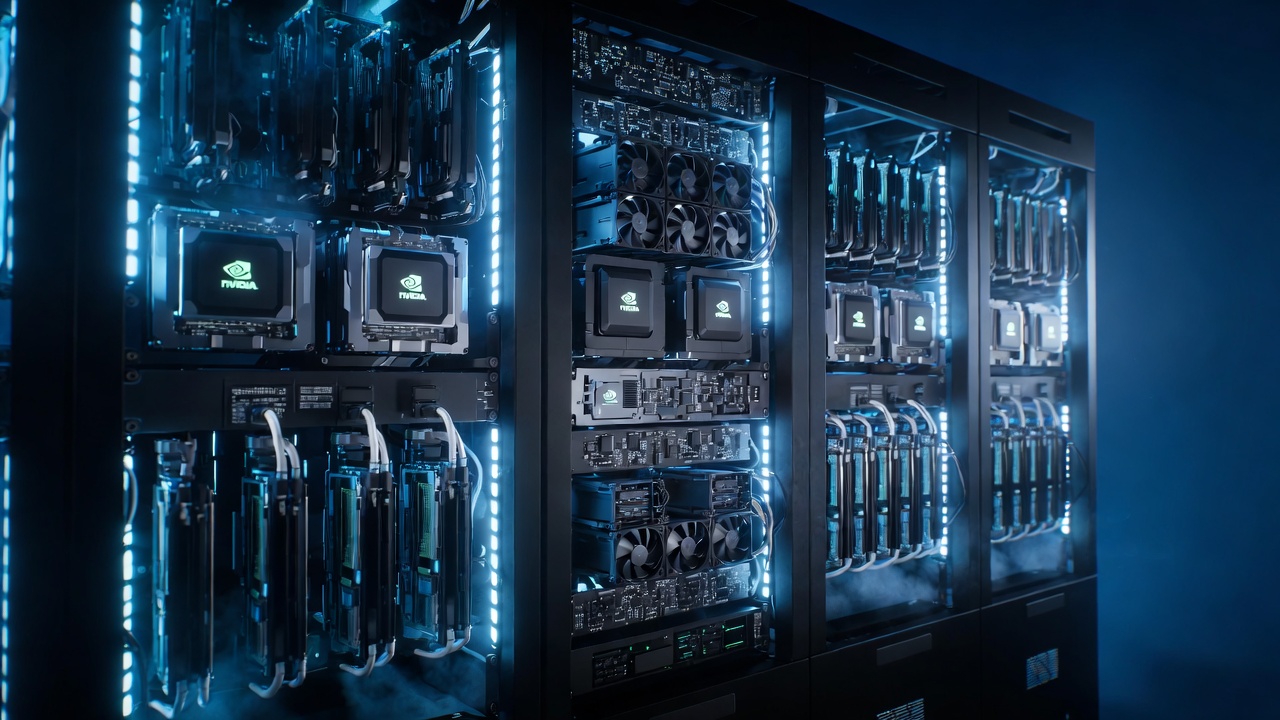
Throughout 2025 and 2026, Nvidia transitioned its primary offering from the Hopper architecture to the Blackwell architecture. This shift represented a change in philosophy: the rack, specifically the GB200 NVL72, became the "unit of measure" for modern data centers. The Blackwell GB200 NVL72 rack integrates 72 GPUs and 36 CPUs into a single, unified liquid-cooled system. This system delivers 1.4 exaflops of AI compute and features 30 TB of fast memory, allowing it to act as a massive single GPU.
The economic significance of Blackwell lies in its inference performance. By 2026, the market has shifted from the "initial land grab" of model training to the "deployment and inference" phase. Blackwell offers a 30x performance increase for LLM inference compared to the previous H100 generation. To capitalize on this, Nvidia introduced Nvidia Inference Microservices (NIMs), pre-optimized containers that allow enterprises to deploy AI models in hours rather than weeks. Analysts project that recurring software revenue from NIMs could reach $5 billion annually by 2027.
The Rubin Revolution: Future Outlook for 2026 and 2027
Nvidia’s aggressive one-year product cadence moves from Blackwell to the newly announced Rubin architecture (R100) in the second half of 2026. The Rubin platform represents the most significant architectural leap in the company's history, targeting the next generation of "Agentic AI"—systems capable of multi-step reasoning and autonomous action. Rubin is built from six new chips, including the R100 GPU and the Vera CPU.
The Vera CPU and custom Olympus Cores
A central component of the Rubin platform is the Vera CPU, which replaces the ARM-based Grace CPU. Vera is built on Nvidia’s custom "Olympus" ARM cores (v9.2-A architecture). This move to custom silicon allows for tighter optimization between the CPU and GPU, specifically for the complex data-shuffling tasks required by multi-agent AI workflows. Vera introduces "Spatial Multithreading," a novel approach where each core's resources are physically partitioned to run two hardware threads simultaneously, ensuring deterministic performance for multi-tenant AI factories.
HBM4 and Silicon Photonics
The Rubin R100 GPU is the first to widely adopt the HBM4 (6th-generation High Bandwidth Memory) standard. These memory stacks, provided by partners like SK Hynix and Samsung, offer a massive jump in capacity and throughput. Rubin also introduces silicon photonics—optical semiconductor technology that uses light signals instead of traditional copper wiring for data transfer. This technology delivers 5x better power efficiency and more than 10x faster transmission speeds.
The leap to 22 TB/s of memory bandwidth is designed to shatter the "memory wall" that has limited the scaling of trillion-parameter models. Rubin is projected to reduce the cost per inference token by 10x compared to Blackwell, signaling the end of the "expensive AI" era.
The Competitive Landscape: AMD’s Strategic Resistance
Despite Nvidia’s dominance, AMD remains a credible and persistent threat. Under CEO Dr. Lisa Su, AMD has adopted a strategy of "openness" and "flexibility" to counter Nvidia’s integrated, proprietary approach. AMD’s Instinct MI300X and newer MI325X/MI355X series prioritize raw memory capacity over Nvidia’s focus on full-rack integration.
Inference Strategy and Hybrid AI
AMD’s Instinct MI300X accelerators have been adopted by Meta to handle live AI traffic, including assistant operations and image generation, due to the hardware's high memory capacity and cost-efficiency. Meta has adopted a "hybrid" strategy: using Nvidia’s systems for large-scale training of models but increasingly relying on AMD for specific AI inference workloads. In 2025, Meta accounted for approximately 42% of AMD's AI GPU sales.
ROCm Maturity and the Triton Revolution
The primary technical hurdle for AMD has been software, but the rise of OpenAI’s "Triton" compiler is beginning to level the playing field. Triton allows developers to write high-performance code that is compatible with both Nvidia and AMD hardware without requiring deep expertise in CUDA. By 2026, many experts believe that "low-level" CUDA programming will become less relevant as abstraction layers and sophisticated compiler stacks handle hardware-specific optimizations. This "abstraction revolution" reduces the switching cost between hardware vendors, providing a pathway for AMD and custom ASIC makers to gain market share.
AMD’s Helios and the blueprint for yotta-scale compute
In early 2026, AMD announced the "Helios" rack-scale platform, its direct answer to Nvidia’s NVL72. Helios integrates 72 MI455X accelerators into a single rack, delivering up to 3 exaflops of AI performance. Unlike Nvidia’s closed system, AMD pitches Helios as "open and modular," leaning into industry-standard networking (Ultra Ethernet) rather than a tightly sealed vertical stack.
Custom Silicon and the Hyperscaler Pivot
While AMD is the primary merchant competitor, Nvidia faces a more existential threat from custom silicon designed by hyperscalers like Google (GOOGL), Amazon (AMZN), and Microsoft (MSFT). These companies are designing their own chips (TPUs, Maia, Inferentia) to lower their total cost of ownership and reduce dependence on a single vendor. Broadcom has emerged as the leading partner for these hyperscalers, providing the networking expertise and IP to build custom AI ASICs. Broadcom recently secured a massive deal to supply 10 gigawatts of custom silicon to OpenAI beginning in 2026—a deal that could represent $350 billion in potential hardware value.
ASICs lack the flexibility of Nvidia’s GPUs but are significantly more cost-efficient for the specific tasks for which they were designed. This becomes even more important as the market turns toward inference, which is an ongoing cost for enterprise data centers. However, Nvidia’s GPUs remain the preferred choice for advanced model training due to their flexibility and the decades of software libraries built on top of CUDA.
Infrastructure Constraints: The Physical Reality of AI scaling
As AI models continue to scale, the limitations are no longer just in the silicon, but in the physical infrastructure of the data center. The power and cooling requirements for next-generation AI "factories" are reaching unprecedented levels.
The Power and Thermal Wall
A single Nvidia Rubin NVL72 rack is projected to consume between 132kW and 150kW, with "Ultra" configurations potentially hitting 600kW per rack. To put this in perspective, a traditional data center typically manages 10kW to 20kW per rack. This 10x-30x increase in power density means that many existing data centers are functionally incompatible with the latest AI hardware without a total electrical and thermal overhaul.
The Liquid Cooling Mandate
At power densities above 40kW per rack, air cooling becomes physically impossible. Consequently, liquid cooling has moved from a niche feature to a non-negotiable requirement for AI infrastructure. Nvidia’s Rubin platform is 100% liquid-cooled. This requires a complex ecosystem of Coolant Distribution Units (CDUs), manifolds, and cold plates that sit directly on the GPUs. The transition to liquid cooling introduces new risks, including material compatibility issues and the potential for corrosion, which requires a greater level of system engineering between the IT systems and the facility infrastructure.
Financial Forensics: The Economics of the Hegemony
Nvidia’s financial performance has been parabolic. For fiscal year 2026, analysts project total revenue to hit $215 billion, a massive leap from the $130.5 billion reported in fiscal year 2025. Gross margins remain exceptionally high at approximately 74-75%, reflecting the company’s absolute pricing power and the scarcity of its systems.
Hyperscaler Capex and the 2026 Inflection Year
The primary driver of Nvidia’s growth is the capital expenditure of the Big Four hyperscalers. In 2025, AI-related Capex reached $405 billion, a figure that is expected to rise to $527 billion in 2026. However, the timing of an eventual slowdown in Capex growth poses a risk to Nvidia’s valuation. Analysts describe 2026 as an "inflection year," where the focus shifts from hardware installation to the potential for AI-enabled revenues.
Valuation Debate: Bubble or Nucleus?
As of early 2026, Nvidia is valued at approximately $4.8 trillion to $5 trillion. Despite this massive valuation, its forward P/E ratio sits at approximately 35x, which many analysts argue is "fair" given its projected earnings growth of over 50%. However, some historical analysts caution that "next-big-thing" technologies—from the internet to the metaverse—have historically endured early innings bubble-bursting events as investors overestimate how quickly businesses can optimize new tools. The "floating-point bubble" argument suggests that scaling AI models with more GPUs may eventually yield diminishing returns per watt and dollar.
Real-World Case Studies: Operational Superiority in 2026
The true test of Nvidia’s moat is not in the benchmarks but in the operational success of the enterprises using its "AI factories." By 2026, several industry leaders have demonstrated how integrated AI stacks translate to the bottom line.
Shopify: Autonomous Commerce at Scale
Shopify has integrated AI directly into its commerce core, using Nvidia’s inference pipelines for autonomous pricing and inventory forecasting. By refusing to treat AI as a "bolt-on" and instead investing in feedback loops, Shopify has seen revenue per merchant climb while support tickets have dropped. For Shopify, AI is no longer a novelty but a utility as essential as electricity.
Moderna: Compressed Discovery Cycles
In the biotech sector, Moderna uses Nvidia’s systems to simulate protein interactions at a scale that was computationally prohibitive five years ago. This has allowed Moderna to iterate on drug discovery weekly rather than quarterly, reducing the number of dead-end trials reaching clinical phases.
JPMorgan Chase: Compliance and Trust
JPMorgan Chase has focused on "explainable" AI for transaction monitoring and risk narratives. By prioritizing audit trails and regulator-readable outputs, the bank has seen false positives fall sharply, allowing analysts to interpret signals rather than clearing noise.
Future Risks and Strategic Resilience
Despite its dominance, Nvidia faces several significant risks. The company is heavily reliant on TSMC for fabrication and SK Hynix/Micron/Samsung for HBM memory—any disruption in the Taiwan Strait would be catastrophic. Furthermore, U.S. export restrictions have hobbled Nvidia's business in China, a region that once accounted for 20-25% of revenue and is now under 10%.
Nvidia’s defensive strategy involves moving faster than the competition. CEO Jensen Huang has set an ambitious goal of bringing a new advanced AI chip to market annually. This aggressive innovation timeline makes it unlikely that external competitors will be able to match Nvidia on a pure compute basis in the near term. By the time a competitor releases a chip that rivals Blackwell, Nvidia will already be shipping Rubin, which promises a 5x increase in performance.
Synthesis: The Three Pillars of the Nvidia Moat
Nvidia’s ability to maintain its hegemony through the end of the decade depends on three non-negotiables:
1. The Full-Stack Integration
Nvidia is no longer a chip company; it is an infrastructure provider. By selling the GPUs, CPUs, networking, and software together as a "deterministic" system, they create an environment where all components are optimized to work perfectly together.1 This "rack-scale" approach is much easier for enterprises to deploy than trying to mix and match components from different vendors.
2. The Software Ecosystem
The 15-year accumulation of CUDA libraries and the 5 million developers using them create a network effect that is nearly impossible to break. Even as abstraction layers like Triton emerge, Nvidia’s ability to release optimized kernels for new model architectures within days ensures they remain the "nucleus" for AI development.
3. The One-Year Innovation Cadence
By accelerating its product lifecycle to a one-year cadence, Nvidia ensures it is always at least one generation ahead of the competition. This "innovation treadmill" forces competitors to compete against a moving target, making it difficult for them to gain a foothold in the high-margin advanced model training market.
Final Conclusion
Nvidia’s dominance is the result of a uniquely long-term vision that anticipated the AI revolution nearly two decades before it occurred. By building a software ecosystem that became the industry standard and a networking backbone that solved the scaling bottleneck, Nvidia created a competitive moat that is as much about human capital—the developers using its platform—as it is about silicon. While AMD and custom ASIC makers will continue to capture segments of the market, Nvidia remains the undisputed sovereign of the AI infrastructure layer, entering fiscal year 2027 in a position of unprecedented strength. The transition to the Rubin architecture in late 2026, with its 10x reduction in inference costs, effectively signals the dawn of a new era of autonomous, agentic systems, with Nvidia at the core of the global digital economy.
Bibliography
AgMark LLC. (2026). The Case for Nvidia Stock Hitting $275 in 2026. https://www.agmarkllc.com/news/story/36751672/the-case-for-nvidia-stock-hitting-275-in-2026
AMD. (2026). AMD and its Partners Share their Vision for “AI Everywhere, for Everyone” at CES 2026. https://www.amd.com/en/newsroom/press-releases/2026-1-5-amd-and-its-partners-share-their-vision-for-ai-ev.html
Carbon Credits. (2025). NVIDIA Controls 92% of the GPU Market in 2025 and Reveals Next Gen AI Supercomputer. https://carboncredits.com/nvidia-controls-92-of-the-gpu-market-in-2025-and-reveals-next-gen-ai-supercomputer/
Chosun Biz. (2026). Nvidia debuts Vera Rubin using HBM4 and silicon photonics to boost AI performance. https://biz.chosun.com/en/en-it/2026/01/15/H4IGA62IFZFMLO7TKL5G2NHAYM/
Digital Journal. (2026). Real-World Case Studies: Companies Winning With AI in 2026. https://www.digitaljournal.com/pr/news/winston-news-wire/real-world-case-studies-companies-winning-1317890528.html
EE Times. (2026). The Trillion-Dollar Race to Fragment the Nvidia Monopoly. https://www.eetimes.com/the-trillion-dollar-race-to-fragment-the-nvidia-monopoly/
EE Times. (2026). Why Nvidia's AI Empire Faces a Reckoning in 2026. https://www.eetimes.com/why-nvidias-ai-empire-faces-a-reckoning-in-2026/
FiberMall. (2026). InfiniBand vs. Ethernet: The Battle Between Broadcom and NVIDIA for AI Scale-Out Dominance. https://www.fibermall.com/blog/infiniband-vs-ethernet-the-battle-between-broadcom-and-nvidia.htm
FinancialContent. (2026). Nvidia (NVDA): The $5 Trillion Engine of the AI Era. https://markets.financialcontent.com/stocks/article/finterra-2026-1-19-nvidia-nvda-the-5-trillion-engine-of-the-ai-era-2026-deep-dive
Goldman Sachs. (2026). Why AI Companies May Invest More than $500 Billion in 2026. https://www.goldmansachs.com/insights/articles/why-ai-companies-may-invest-more-than-500-billion-in-2026
IDTechEx. (2026). Thermal Management For Data Centers 2026-2036: Technologies, Markets, and Opportunities. https://www.idtechex.com/en/research-report/thermal-management-for-data-centers/1128
Intellectia AI™. (2026). Nvidia NVDA $500 Price Target 2026. https://intellectia.ai/blog/nvidia-nvda-price-target-2026
Investing.com. (2026). Nvidia vs. Broadcom: Which AI chip stock to own for 2026? Analyst answers. https://www.investing.com/news/stock-market-news/nvidia-vs-broadcom-which-ai-chip-stock-to-own-for-2026-analyst-answers-4412592
IO Fund. (2026). Big Tech's $405B Bet: Why AI Stocks Are Set Up for a Strong 2026. https://io-fund.com/ai-stocks/ai-platforms/big-techs-405b-bet
Jon Peddie Research. (2026). Meta plays hybrid AI. https://www.jonpeddie.com/news/meta-plays-hybrid-ai/
Markets Financial Content. (2026). NVIDIA Rubin Architecture Unleashed: The Dawn of the $0.01 Inference Era. https://markets.financialcontent.com/stocks/article/tokenring-2026-1-20-nvidia-rubin-architecture-unleashed-the-dawn-of-the-001-inference-era
Markets Financial Content. (2026). The Rubin Revolution: NVIDIA Accelerates the AI Era with 2026 Launch of HBM4-Powered Platform. https://markets.financialcontent.com/worldnow.katv/article/tokenring-2026-1-1-the-rubin-revolution-nvidia-accelerates-the-ai-era-with-2026-launch-of-hbm4-powered-platform
Medium (elongated_musk). (2026). Rubin-Class Shift and Its Implications for AI Infrastructure. https://medium.com/@Elongated_musk/rubin-class-shift-and-its-implications-for-ai-infrastructure-e66ce4cd61cc
Medium (Ilan Poonjolai). (2026). AMD's Helios moment at CES 2026: the “AI factory” fight just got real. https://medium.com/@ilanpoonjolai/amds-helios-moment-at-ces-2026-the-ai-factory-fight-just-got-real-0814f909fb3e
Medium (John Paul Prabhu). (2025). Triton Kernel Programming vs CUDA: The New Way to Write Deep Learning Kernels. https://medium.com/@jpprabhu2315/triton-kernel-programming-vs-cuda-the-new-way-to-write-deep-learning-kernels-e368c5ac0aa7
Medium (Sohail Saifi). (2026). The GPU Programming Revolution Coming in 2026 That Will Make Current ML Engineers Obsolete. https://medium.com/@sohail_saifi/the-gpu-programming-revolution-coming-in-2026-that-will-make-current-ml-engineers-obsolete-09690964cea7
Moomoo Community. (2026). Will AMD's New AI Chip Stack Up Against Nvidia? https://www.moomoo.com/community/feed/will-amd-s-new-ai-chip-stack-up-against-nvidia-113293401915397
Nasdaq. (2026). 90% of Nvidia's Customers Now Buy This -- and It's Not GPUs. https://www.nasdaq.com/articles/90-nvidias-customers-now-buy-and-its-not-gpus
Nasdaq. (2026). Nvidia Stock in an AI Bubble? The AI Giant's Fantastic Q3 Results and Guidance Should Put That Concern to Rest. https://www.nasdaq.com/articles/nvidia-stock-ai-bubble-ai-giants-fantastic-q3-results-and-guidance-should-put-concern-rest
Nasdaq. (2026). Nvidia vs. Broadcom: Which Is the Better AI Chip Stock to Own in 2026? https://www.nasdaq.com/articles/nvidia-vs-broadcom-which-better-ai-chip-stock-own-2026
NVIDIA. (2026). Inside the NVIDIA Rubin Platform: Six New Chips, One AI Supercomputer. https://developer.nvidia.com/blog/inside-the-nvidia-rubin-platform-six-new-chips-one-ai-supercomputer/
NVIDIA. (2026). Next Gen Data Center CPU | NVIDIA Vera CPU. https://www.nvidia.com/en-us/data-center/vera-cpu/
NVIDIA. (2026). NVIDIA Kicks Off the Next Generation of AI With Rubin — Six New Chips, One Incredible AI Supercomputer. https://nvidianews.nvidia.com/news/rubin-platform-ai-supercomputer
NVIDIA. (2026). Rack-Scale Agentic AI Supercomputer | NVIDIA Vera Rubin NVL72. https://www.nvidia.com/en-us/data-center/vera-rubin-nvl72/
S&P Global Ratings. (2026). Research Update: NVIDIA Corp. Outlook Revised To. https://www.spglobal.com/ratings/en/regulatory/article/-/view/type/HTML/id/3463382
Schneider Electric. (2026). Liquid cooling for AI data centers: 3 risks and how a trusted partner ensures success. https://blog.se.com/datacenter/2026/01/12/liquid-cooling-for-ai-data-centers-3-risks-and-how-a-trusted-partner-ensures-success/
SemiWiki. (2026). AMD Stock Tumbles After Unveiling New AI Chip. It Might Not Beat Nvidia's Blackwell. https://semiwiki.com/forum/threads/amd-stock-tumbles-after-unveiling-new-ai-chip-it-might-not-beat-nvidia%E2%80%99s-blackwell.21195/
Storage Review. (2026). MLPerf Inference v5.1: NVIDIA Blackwell Ultra vs. AMD Instinct Platforms. https://www.storagereview.com/news/mlperf-inference-v5-1-nvidia-blackwell-ultra-vs-amd-instinct-platforms
Tech in Asia. (2026). Broadcom launches new networking chip to challenge Nvidia. https://www.techinasia.com/news/broadcom-launches-new-networking-chip-to-challenge-nvidia
Tech Research Online. (2025). NVIDIA vs AMD (2025): GPUs, AI & Market Share. https://staging.techresearchonline.com/blog/nvidia-vs-amd-the-gpu-battle-for-ai-dominance/
The Motley Fool. (2025). Will the Bubble Burst on Artificial Intelligence (AI) Stocks Nvidia and Palantir in 2026? https://www.fool.com/investing/2025/12/17/bubble-burst-ai-stocks-nvidia-pltr-2026-history/
The Straits Times. (2026). Nvidia says its revenue forecast has grown more bullish. https://www.straitstimes.com/business/companies-markets/nvidia-says-its-revenue-forecast-has-only-grown-more-bullish
TrendForce. (2026). InfiniBand vs Ethernet: Broadcom and NVIDIA Scale-Out Tech War. https://www.trendforce.com/insights/infiniband-vs-ethernet
Virtue Market Research. (2026). AI Infrastructure Procurement in 2026: GPUs, Networking, Cooling, and the Real Bottlenecks. https://virtuemarketresearch.com/news/ai-infrastructure
Wccftech. (2026). NVIDIA Rubin Is The Most Advanced AI Platform On The Planet. https://wccftech.com/nvidia-rubin-most-advanced-ai-platform-50-pflops-vera-cpu-5x-uplift-vs-blackwell/